
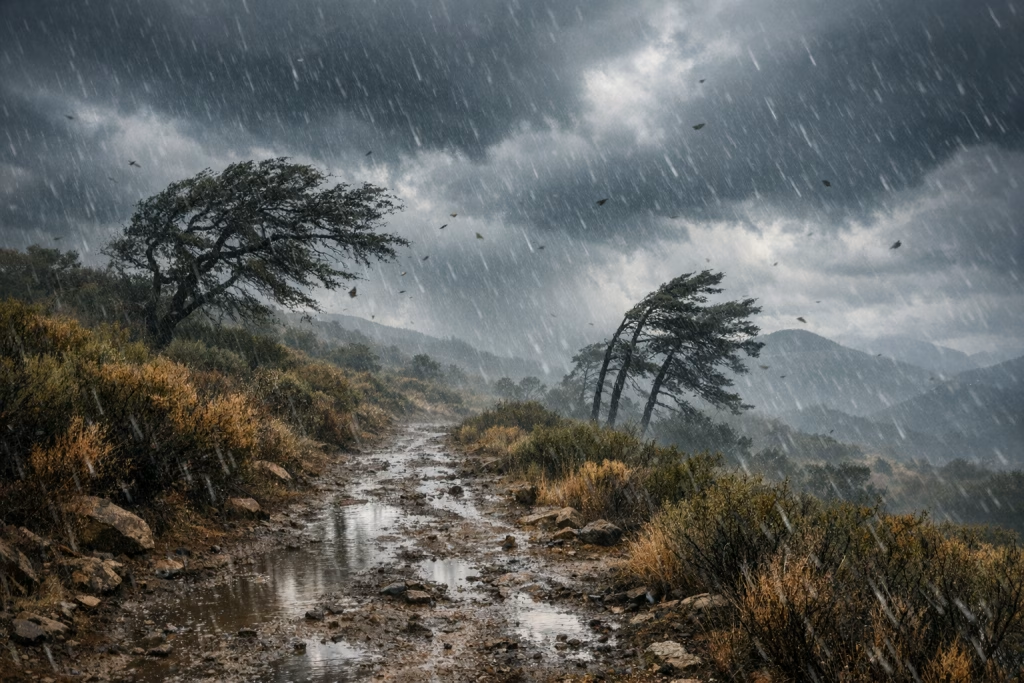
San Diego Storm Records 2025-2026 Rain and Wind Summary
I’ve got a soft spot for weather logs. Maybe you do too. They’re oddly grounding: a handful of numbers, a short note about wind rattling a fence, and suddenly a whole season comes back to life. In this post, I’ll walk you through a set of storm and rainfall notes from the Elfin Forest area in San Diego County, covering 2025–2026, and I’ll translate them into something you can actually use—whether you’re planning travel, tracking local climate patterns, or you simply want to understand how “sunny California” still gets properly soaked now and then.
We’ll focus on rain totals, wind gusts, and how local readings compared with nearby National Weather Service (NWS) station reports mentioned in the source notes. I’ll also keep the language practical: what happened, when it happened, and what it suggests about the county’s microclimates—coastal, inland valleys, and the mountains.
Quick note on names and sources: the source material references an “Elfin Forest” station around 777 feet elevation and compares readings to NWS locations such as Oceanside, Carlsbad, Poway, La Mesa, Ramona, Escondido, and Julian. Those place names are real communities in San Diego County, and the National Weather Service does operate climate reporting through a network of stations, co-op observers, and related feeds. I’m treating the rain-and-wind figures as log-style observations rather than an audited climate dataset.
What these Elfin Forest storm notes capture (and why they’re useful)
If you live outside Southern California, it’s easy to picture San Diego County as endless blue skies and outdoor brunch. You aren’t entirely wrong, of course—but the inland ridges and foothills can sit right in the path of winter systems, and the mountains can amplify totals dramatically.
These notes help because they do three things at once:
- They timestamp storms (often down to overnight windows).
- They track accumulation over one or two days, which matters for runoff and soil saturation.
- They pair local totals with nearby comparisons, which gives you a feel for microclimate swings (especially the classic “Julian gets more” pattern).
When I read logs like this, I don’t just see weather trivia. I see planning value. If you hike, drive canyon roads, manage outdoor work, or run a local service business, patterns like “multiple storms within a week” or “gusts above 50 mph” should change your week.
San Diego County’s microclimates in plain English
Before we get into the timeline, it helps to set expectations. San Diego County behaves like several climates stitched together.
Coast versus inland valleys versus mountains
- Coastal zone (e.g., Oceanside, Carlsbad): often cooler, marine-layer prone, and sometimes lighter on rainfall totals compared with inland lift zones.
- Inland valleys and foothills (e.g., Escondido area): can pick up meaningful rain totals when systems push inland and terrain forces uplift.
- Mountain communities (e.g., Julian area): frequently see higher totals, and winter storms can turn into major snow events at elevation.
The notes you provided keep returning to this theme: the same storm can look “moderate” in one place and “serious business” just 30–60 miles away.
Timeline: Storm and rainfall highlights from 2025 to 2026
I’ll go season by season, then pull the numbers together into a summary you can scan quickly.
Early 2025: Light showers and short bursts
The notes for early 2025 show a familiar Southern California rhythm: a few light events that add up slowly, with one or two days doing most of the work.
- 6 February 2025: about 0.02 inches from light showers.
- 12 February 2025: about 0.13 inches from light rain—small, but it signalled more active patterns ahead.
When I see several “0.02” or “0.05” style days in a log, I treat them as important background. They don’t look dramatic, but they prime the ground. The next heavier storm then runs off faster, and that affects trails, streets, and hillside drainage.
March 2025: A more organised rain event
March brought a more coherent system in the notes, including what was described as a “blob” style storm profile—typical of convective clusters or uneven bands.
- 11 March 2025: about 0.44 inches, with heavier rain in the afternoon.
- 12 March 2025: about 0.02 inches overnight, bringing a running total in that period to about 0.46 inches.
Those are the days that change the feel of a season. You can go from dusty to green surprisingly quickly after a half-inch event, especially if it lands on cooler days with less evaporation.
Late summer 2025: Thunderstorm activity inland
By September, the notes mention thunderstorms over the interior spine—consistent with late-summer monsoonal moisture episodes that can drift into Southern California.
- 3 September 2025: thunderstorms reported; examples in the notes include Ramona around 0.30 inches and Julian around 0.03 inches over a 24-hour window.
That’s a good reminder: convective storms can be wildly uneven. One neighbourhood gets a proper downpour, another gets a few drops and a dramatic sky for Instagram.
Autumn 2025: A wetter stretch in November
The November sequence stands out as an active spell, with several events stacking close together. In practical terms, closely spaced storms tend to cause more issues than a single storm with the same combined total, because the second or third event arrives before the ground dries out.
Mid-November 2025: Multiple storms, meaningful totals
- 15 November 2025: heavy rain noted, around 1.38 inches.
- 16 November 2025: another strong event, around 1.54 inches by morning.
- 18 November 2025: around 0.73 inches overnight.
- 20 November 2025: around 0.12 inches in the evening.
- 23 November 2025: around 0.46 inches after light showers, described as a “third storm” in that run.
If you add up the bigger entries alone (1.38 + 1.54 + 0.73), you’re already at 3.65 inches in that November cluster before you even count the smaller follow-ups. For many parts of San Diego County, that’s a substantial chunk of seasonal rainfall concentrated into a short period.
From a safety and planning angle, this is when you start caring about:
- wind stress on trees after saturated soil loosens root grip,
- pooling on roads (first major rains plus oils on pavement),
- trail washouts and soft slopes.
December 2025: Holiday rain and a notable Christmas Eve total
December continues the on-and-off pattern, but the notes highlight Christmas Eve as a stronger day.
- 24 December 2025: about 0.65 inches, with the notes also mentioning far heavier totals elsewhere (including the idea of extremely high mountain totals during that broader weather system).
- 27 December 2025: about 0.29 inches in evening rain (with a note that comparisons weren’t made due to timing changes).
I’ve spent enough time watching winter forecasts to know how often holiday travel collides with weather windows. Even 0.65 inches can create messy driving if it lands fast, especially at night. It also matters for canyon routes and rural roads where drainage varies.
January 2026: Small events, steady accumulation
January looks quieter in the notes, but still active enough to keep the season from going dry.
- 3 January 2026: about 0.05 inches from light showers and fog.
- 4 January 2026: about 0.20 inches, pushing the January total mentioned in the notes to about 1.82 inches at that time.
- 5 January 2026: about 0.49 inches overnight; the two-day sum referenced sits around 0.59 inches.
- 24 January 2026: around 0.05 inches across two days.
One thing I like about this section is how “small” numbers still sketch a real winter. If you’re managing irrigation, landscaping, or outdoor work, those light events can still buy you time.
February 2026: Three storms, peak winds, and the strongest “series” signal
This is the headline chapter. The notes describe a three-storm sequence in February 2026, including wind gusts into the 50+ mph range and a multi-storm accumulation that ends up near 2.48 inches for the series.
Storm 1: 16 February 2026
- Light rain beginning late morning (around 11 a.m. in the notes).
- Peak wind gust around 46 mph.
Even without a named rainfall total attached to that first entry, the wind figure matters. Gusts in the mid‑40s tend to bring down branches, shift unsecured outdoor items, and make some driving unpleasant—especially high-profile vehicles.
Storm 2: 18 February 2026
- Heavy rain overnight.
- Peak wind gust around 54 mph.
- Storm rainfall noted around 0.44 inches.
- Two-storm combined total referenced around 1.89 inches.
The comparison points in the notes matter here. They cite example totals such as:
- Oceanside: around 1.36 inches (with a confusing parenthetical in the source note, which I’m not going to “fix” by guessing).
- Poway: around 2.08 inches.
- Julian: around 4.78 inches, plus mention of substantial mountain snow in Southern California ranges during that broader storm cycle.
That spread is classic. Inland and higher elevations often overperform. Coastal sites may still do well, depending on storm track, but the mountains frequently steal the show.
Storm 3: 20 February 2026
- Rainfall around 0.59 inches.
- Peak wind gust around 36 mph.
- Three-storm combined total referenced around 2.48 inches.
- Comparison examples: La Mesa about 0.59, Julian about 0.95, Poway about 0.57.
This third storm reads like the closing act: less fierce wind, still enough rain to keep the ground wet, and a tidy set of comparisons that show how totals can line up more closely across the county when the system spreads more evenly.
Rain totals and wind gusts at a glance (based on the notes)
Here’s a condensed view of the biggest numbers mentioned, so you can scan without rereading the whole timeline.
Selected storm totals
- 16 November 2025: ~1.54 inches
- 15 November 2025: ~1.38 inches
- 18 November 2025: ~0.73 inches
- 24 December 2025: ~0.65 inches
- 11 March 2025: ~0.44 inches
- 18 February 2026: ~0.44 inches (plus a multi-storm total cited as ~1.89 inches)
- 20 February 2026: ~0.59 inches (series total ~2.48 inches)
Peak wind gusts
- 18 February 2026: ~54 mph
- 16 February 2026: ~46 mph
- 20 February 2026: ~36 mph
I’ll be honest: I’m always more wary of the wind number than the rain number. Rain usually gives you some warning and you can slow down. Wind gusts around 50 mph can go from “bit blustery” to “there goes the patio umbrella” in seconds.
What the comparisons tell you about San Diego County rainfall
The notes repeatedly compare the Elfin Forest-area readings with NWS-reported totals from nearby communities. This is where the log turns from personal journaling into a mini lesson on regional meteorology.
Julian often records higher totals
Julian appears in multiple comparisons as a higher-total site, including a standout 4.78 inches figure during the February 2026 storm sequence. That aligns with what you’d expect from elevation and orographic lift.
If you plan a winter drive or weekend trip into higher elevations, treat coastal forecasts as a starting point, not the full story.
Coastal totals can look “moderate” even during a countywide event
Coastal examples like Oceanside show meaningful rain (the notes cite about 1.36 inches in one comparison), yet they may sit below inland hotspots during certain storm tracks.
In practical terms, if you live inland and your friend near the beach says, “It barely rained,” you don’t need to argue. You can both be right.
Short-distance variability is normal
The thunderstorm mention in September 2025 makes that point perfectly. Convective rain doesn’t care about city boundaries. It drops where it drops.
How to use this kind of storm log in real life
You might be reading this as a weather enthusiast, but you can also treat it like a planning tool. Here’s how I’d use it if I lived in the area.
1) Travel and outdoor planning
- If the pattern shows back-to-back storms (like November 2025 or February 2026), plan for muddy trails and standing water even after the rain stops.
- If gusts push into the mid‑40s to 50s mph, consider safer routes, avoid parking under questionable trees, and secure outdoor gear.
2) Property and maintenance routines
- Clean gutters before the season turns active; a 0.65-inch day can overwhelm neglected drainage surprisingly fast.
- After the first big rains, check downspout discharge paths and any signs of slope movement.
3) Local business operations
I work in marketing and automation, and I can’t help noticing how weather ties directly into operations. If you run services like landscaping, pest control, roofing, exterior cleaning, or solar maintenance, these patterns can feed your planning.
- Use storm sequences to adjust staffing and scheduling.
- Trigger customer messages after multi-storm cycles (for example: “we’re opening extra slots for gutter checks this week”).
- Track repeatable seasonal windows year over year.
When I build automations for teams, I often suggest pairing a weather feed with your CRM. You don’t need anything fancy—just enough to act quickly when conditions change.
Practical SEO notes: phrases people actually search for
If you publish local weather summaries, you’ll usually get the best organic reach by sticking to clear, place-based terms. The content you’re reading naturally supports searches such as:
- San Diego storm records 2025 2026
- Elfin Forest rain totals
- San Diego County rainfall summary
- February 2026 San Diego storms wind gusts
- Julian rainfall compared to coastal San Diego
- San Diego winter storms rain and wind
I’m mentioning this because I’ve seen too many posts bury the obvious terms. If you want people to find your work, you’ve got to meet them where their search bar lives.
Data quality and interpretation: a respectful reality check
I trust logs like these as an on-the-ground narrative, but I don’t treat them as gospel. Timing methods vary. Station exposure varies (wind readings especially). And sometimes the source note itself flags uncertainty—like the “wait, typo?” style aside in the comparisons.
Here’s how I’d interpret responsibly:
- Use the figures as directionally accurate and helpful for pattern recognition.
- Cross-check specific “record” claims against official NWS climate summaries if you plan to cite them formally.
- Assume wind gusts may differ based on sensor height and siting, even within the same neighbourhood.
That said, the overall story holds together well: late 2025 and early 2026 featured multiple impactful rain events with at least one windy February sequence.
My takeaways from these 2025–2026 notes (and what you can watch for next)
I’ll keep this grounded. Three things jump out at me.
1) Clusters matter more than single days
November 2025 reads like a sequence that reshaped conditions—wet ground, recurring showers, and cumulative totals that add up quickly. If you tend to look only at “today’s rain,” you can miss the bigger risk picture.
2) Wind is the sleeper variable
The February 2026 gusts—46 mph and 54 mph—tell me those storms had a stronger impact footprint than rainfall totals alone might suggest. If you live near tall trees or you manage outdoor work, wind deserves its own checklist.
3) The mountains keep proving the point
Julian’s higher totals in the comparisons reinforce the county’s geography lesson: elevation changes outcomes. That’s not academic; it changes driving conditions, snow risk, and even weekend plans.
Reference-style storm recap (simple and readable)
If you want a quick recap you can copy into your own notes, here it is.
Notable rain days mentioned
- 11 Mar 2025: ~0.44 in
- 12 Mar 2025: ~0.02 in (period total ~0.46 in)
- 15 Nov 2025: ~1.38 in
- 16 Nov 2025: ~1.54 in
- 18 Nov 2025: ~0.73 in
- 20 Nov 2025: ~0.12 in
- 23 Nov 2025: ~0.46 in
- 24 Dec 2025: ~0.65 in
- 27 Dec 2025: ~0.29 in
- 3 Jan 2026: ~0.05 in
- 4 Jan 2026: ~0.20 in (month noted around 1.82 in at that point)
- 5 Jan 2026: ~0.49 in (two-day sum ~0.59 in)
- 20 Feb 2026: ~0.59 in (three-storm sum ~2.48 in)
Notable wind gusts mentioned
- 16 Feb 2026: ~46 mph
- 18 Feb 2026: ~54 mph
- 20 Feb 2026: ~36 mph
If you want to turn weather logs into business value (a quick, practical aside)
I know you came here for storm records, not a sales pitch, so I’ll keep it straightforward. At Marketing-Ekspercki, we often help teams connect “real-world signals” to “real-world actions.” Weather is one of the clearest signals you can use because it changes demand immediately.
If you want, you can automate simple flows in tools such as Make or n8n:
- When forecast rain exceeds a threshold, notify your crew in Slack or email.
- After a windy night, generate a call list for clients likely to need inspections.
- Log rain and gust data daily into a sheet, then produce weekly summaries for planning.
I’ve set up systems like this, and—well—it’s a small effort that saves a surprising amount of back-and-forth.
Closing thought
These 2025–2026 Elfin Forest notes read like a reminder that San Diego County weather keeps its own counsel. Most days feel mild. Then a November cluster drops multiple inches, or a February series brings gusts above 50 mph, and the “always sunny” story needs a footnote.
If you track weather where you live, keep going. Your future self will thank you. And if you don’t track it yet, you might start with something simple: date, rainfall total, peak gust, and a one-line description. It sounds almost quaint, but it adds up into a record that’s genuinely useful.