
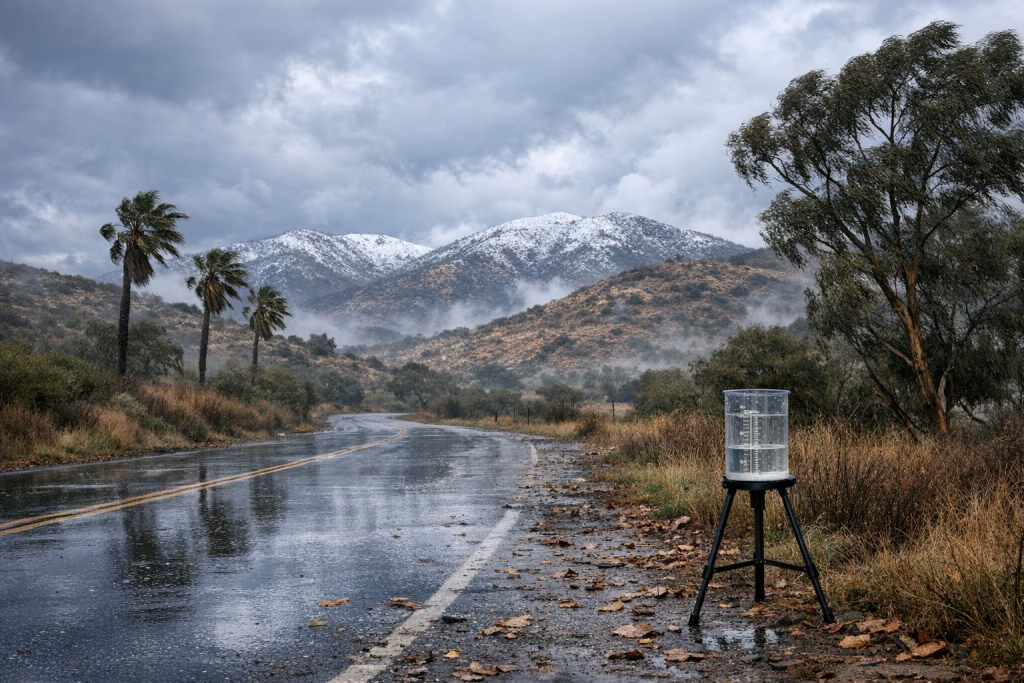
San Diego Storm Chronicles Winter 2025–2026 Rainfall Insights
I’ve always had a soft spot for weather logs. Not the glossy “big storm hits the coast” headlines, but the day-to-day notes that come from someone actually watching the sky, checking a rain gauge, and writing things down while the kettle’s on. If you live in or around San Diego County (or you sell, plan, build, or insure things there), those notes can tell you a lot: how fast conditions change, where rain really falls, and why one neighbourhood gets drenched while another barely notices.
This post pulls together a set of storm-and-rain observations from winter 2025–2026 around inland coastal North County San Diego—often referenced against National Weather Service (NWS) area totals such as Oceanside, Carlsbad, and Julian. I’ll walk you through what happened month by month, explain what the numbers mean in plain English, and share the practical lessons I’ve learned from looking at rainfall data in a “marketing brain” way: patterns matter, local context matters, and tiny details tend to decide outcomes.
If you’re searching for San Diego winter storms 2025 2026, San Diego rainfall totals, Elfin Forest rain gauge, North County San Diego storm recap, or Julian rainfall compared to San Diego, you’re in the right place.
What this blog-style record actually captures (and what it doesn’t)
These storm chronicles come from personal rain-gauge observations in the Elfin Forest area (often described as around 777 feet elevation, between Encinitas and Escondido), with comparisons to broader NWS reporting points such as Oceanside, Carlsbad, and Julian. In other words: hyper-local measurements paired with regional reference data.
That mix is useful because it mirrors how real rainfall behaves here. San Diego County weather can flip quickly with terrain, exposure, and storm track. A “countywide” figure often hides the interesting part: the uneven distribution.
How to read the numbers
- “Inches” refer to rainfall depth: how much water would sit on a flat surface if it didn’t run off.
- Storm totals often combine multiple bursts across a day or two; sometimes a calm-looking period still adds measurable drizzle overnight.
- Wind gusts (MPH) matter because they signal frontal passage intensity and can line up with heavier rain bands.
- Mountain snow often appears alongside these winter systems; even when coastal rain feels modest, higher elevations can get hammered.
One caution, though: I’m not treating these notes as an official climatology paper. A personal gauge can sit in a micro-pocket (trees, rooflines, slope exposure), and NWS stations vary too. Still, when you see repeated patterns—Julian routinely turning in higher totals, for instance—you’re looking at the county’s geography teaching the same lesson again and again.
Winter 2025–2026 in context: calm moments, sharp bursts, and plenty of contrast
When people picture San Diego, they picture beaches, sunshine, and that “permanent mild” vibe. The winter of 2025–2026 doesn’t cancel that image, but it does add nuance. Several storms delivered meaningful rain, periods of strong wind, and even major mountain snow. Meanwhile, some coastal and urban spots stayed comparatively light.
I’ve noticed that locals often remember winter weather as a single story—“it was wet” or “it didn’t rain much.” These logs push back on that. The reality reads more like a playlist: short tracks, a few loud ones, a couple of slow, drizzly interludes, and the occasional surprise drop.
January 2026: light rain, drizzle, and those classic coastal fog vibes
January opened with relatively modest events—more “keep your jacket by the door” than “cancel your plans.” Yet even small numbers matter in Southern California, particularly after dry stretches when soils turn hydrophobic and runoff spikes.
January 2–5: small totals, but consistent moisture
Early January notes describe light rain and drizzle adding 0.07 inches on the evening/night of January 2, bringing a reported storm sum to 1.87 inches at that point in the running seasonal context. The following night (January 3) added 0.05 inches via fog and light showers—exactly the sort of weather that doesn’t look dramatic on camera but steadily dampens surfaces and keeps roads slick.
Then came a more distinct burst on January 4: a short, heavy downpour delivered 0.10 inches in the afternoon. Overnight into January 5, light-to-moderate rain added 0.49 inches. Together, that two-day period reached 0.59 inches.
I like this sequence because it shows how San Diego rain often works: a punchy burst, then the quieter, longer tail that actually adds up. If you’ve ever checked the forecast, shrugged, and then wondered why your driveway stayed wet all morning, this is why.
Late January: “quiet” doesn’t mean “nothing”
By January 24, the notes reference a total holding around 0.05 inches in a two-day reporting window (as relayed via NWS-style summaries). That’s not headline material, but it’s part of the texture of the season—small events that keep vegetation ticking and can still affect morning commutes.
February 2026: three storms, real wind, and a countywide reminder that terrain runs the show
February is where the record gets lively. A series of three storms moved through, each carrying not only rain but notable wind gusts. If you live near canyons, ridgelines, or exposed inland corridors, you already know wind can be the loudest part of the experience.
Storm 1 (around February 16): building rain and a 46 MPH gust
On February 16, light rain began around late morning and strengthened by early afternoon as a front approached. The wind peaked around 46 MPH. Even without a massive rainfall figure attached to that single line in the notes, the signal is clear: this was a proper frontal passage with enough energy to shake trees and push moisture bands inland.
From my perspective, these are the storms that test small practical things: gutters, patio covers, the “temporary” outdoor storage box you never quite moved, and the habit of driving a little too confidently on the first wet day after a dry spell.
Storm 2 (around February 18): heavy overnight rain plus 54 MPH gusts
The second storm hit harder, especially overnight into February 18. The notes cite gusts of 44 MPH at about 2:30 a.m. and 54 MPH around 4:10 a.m.—the sort of wind that wakes you up and has you listening for the tell-tale sound of a loose gate.
Rainfall for this second storm is logged around 0.44 inches, and the combined total for the first two storms is given as 1.89 inches.
That combination—overnight heavy rain plus high gusts—matters because it often leads to:
- Downed branches and spotty power issues in more exposed areas
- Short-lived pooling on roads where drainage can’t keep pace
- Rapid temperature drops behind the front, supporting mountain snow
Storm 3 (around February 20): 0.59 inches and “one more round” winds
The third storm arrived on February 20, with winds around 36 MPH in late afternoon and rainfall noted at 0.59 inches. The three-storm series total is reported as 2.48 inches.
What I find telling is how the region-wide comparisons light up here. Nearby reference points include:
- Julian: 4.78 inches (with 1.62 inches attributed to the last storm)
- Ramona: 2.61 inches
- Poway: 2.08 inches
And then the mountain note: the San Bernardino Mountains reportedly picked up 2–3 feet of snow during this pattern. Even if you live far from those peaks, that snowpack and cold air presence often sits in the background of these coastal rain events, shaping how cold the nights feel and how “sharp” the storms seem.
Why Julian so often tops the charts
If you’ve ever driven from the coast up towards Julian, you’ve felt the transition: marine air gives way to higher terrain, temperatures drop, clouds thicken, and precipitation increases. Orographic lift—air being forced upward by mountains—helps wring out moisture. The logs reflect that familiar reality: Julian frequently leads.
I’ve used this exact idea in client work, oddly enough. When you see geographic patterns repeat, you stop guessing and start planning. Same principle, different context.
December 2025 and November 2025: a wetter rhythm, including a standout November event
Stepping back into late 2025, these notes describe a run of storms that—while not necessarily catastrophic—add up in a way that shapes soil moisture, vegetation growth, and even local sentiment (“Is it me, or has it rained a lot this year?”).
December 24–27, 2025: bands of rain and a Christmas-week total
On December 24, rain bands moved through with heavier bursts, producing about 0.65 inches in the observed gauge record. The notes also mention far larger totals in other parts of Southern California (including Los Angeles region and mountains), reportedly reaching around 10 inches in the hardest-hit areas mentioned in that source summary. I’m careful with that figure because totals depend heavily on exact location and official reporting, but the broader point stands: the system carried serious moisture somewhere in the region.
On December 27, lighter rain added around 0.29 inches across the night and day period described.
November 15–23, 2025: the month that quietly did a lot of work
November stands out in these notes because it contains a heavier early event and then a sequence of follow-ups that kept the pattern active.
On November 15, heavy rain in the morning pushed totals to about 1.38 inches by 4:00 p.m., followed by drizzle. By the morning of November 16, the total reached 1.54 inches.
A second storm beginning around November 18 in the evening added around 0.73 inches.
A third event kicked off around November 20 with about 0.12 inches initially, followed by additional showers adding around 0.46 inches by November 23.
The notes mention forecasts calling for around 1 inch along the coast, with outcomes coming in lower in the specific logged area—another familiar Southern California story. Forecasts often nail the overall pattern, but neighbourhood-level results vary, especially when storm bands wobble north or south by a few miles.
Earlier 2025 episodes: March surprises, light winter showers, and a September inland thunder note
Although the focus sits on winter 2025–2026, the record also references earlier 2025 events that help you see seasonality: late-winter light showers, spring systems that sometimes “blob” over one area, and occasional late-summer thunderstorms inland.
February 2025: small events, measurable nonetheless
Two light February entries stand out:
- February 6: about 0.02 inches
- February 12: about 0.13 inches, with forecasts at the time suggesting higher potential totals over a two-day window
If you’ve lived here a while, you know these tiny amounts still affect trail conditions and canyon roads. A “mere tenth of an inch” can make a clay-heavy path feel like soap.
March 2025: heavier rain pockets (“blob” behaviour) and a front that broke apart
March includes a noteworthy “blob” event around March 7, producing about 1.53 inches in the log. Another entry around March 11 describes a front breaking apart, yielding about 0.44 inches with heavier rain later in the day.
That “blob” description rings true for anyone who watches radar around here: sometimes a single cell or band parks itself over one inland corridor and does the job of three normal showers.
April 26, 2025: small showers
On April 26, showers added around 0.08 inches across night and day. Not dramatic, but it fits that spring pattern of “one more little system” before summer dryness takes over.
September 3, 2025: inland thunderstorms get the attention
A September note references thunderstorms over the interior with around 0.30 inches in Ramona and 0.03 inches in Julian (as cited in the summary). San Diego’s late-summer convection can feel oddly local: one neighbourhood hears thunder, another stays bone-dry and just gets the humidity.
Comparing locations: what the spread tells you about San Diego County rainfall
One of the most useful parts of the record is the repeated comparison between a specific inland foothill gauge and wider reported totals. After the February storms, a referenced snapshot included:
- Rancho Bernardo: 1.88 inches
- La Mesa: 1.98 inches
- San Diego (city context): 1.16 inches
This spread doesn’t mean any one figure is “right” and another is “wrong.” It means rainfall is patchy, and the county’s microclimates show up even within what many people casually call “San Diego.”
When you plan anything that depends on weather—construction scheduling, event planning, landscaping, property maintenance, even retail inventory (umbrellas sell fast in the right postcodes)—you should treat rainfall as a local variable, not a single number.
Practical takeaways if you live in North County or inland-coastal areas
I’ll keep this grounded. When I read these logs, I don’t only see pretty numbers; I see reminders of what tends to go wrong in real life, especially during multi-storm sequences like February 2026.
1) Wind matters as much as rain
Gusts in the 40–50+ MPH range (as noted in mid-February) can cause more day-to-day disruption than the rainfall totals themselves. If you want to be sensible about it:
- Check fences, gates, and lightweight outdoor items before the front arrives.
- Trim weak branches ahead of peak winter storm season if you can do so safely and legally.
- Expect debris on roads in canyon areas after overnight gusts.
2) Small totals still change driving conditions
Those January drizzle-and-fog totals—0.05 here, 0.07 there—can be the slipperiest. Oil rises after dry periods, and the first wetting can turn intersections into skating rinks. I’ve learned to treat the first rainy commute as a different category of risk, even when the radar looks unimpressive.
3) If you want “the wettest story,” look upslope
Julian repeatedly posting higher totals fits the larger pattern. If you garden, hike, or manage land, upslope zones often show you what the atmosphere was capable of—even when the coast got a lighter version of the same system.
How I’d turn storm logs into something useful for a business (a quick marketing-and-ops lens)
I work with marketing operations and automation, so I can’t help seeing a weather log as a dataset begging for structure. If you run a local business—landscaping, roofing, restoration, outdoor services, even hospitality—you can treat storm sequences as demand signals.
Turning “notes” into a simple dataset
If it were my project, I’d capture each event like this:
- Date range (start/end)
- Local rain total (inches)
- Peak wind gust (MPH) if known
- Nearby reference totals (Oceanside/Carlsbad/Julian, etc.)
- Impact notes (flooded intersection, downed branches, trail closures)
From there, you can do surprisingly practical things: correlate inbound calls to rainfall, trigger email/SMS check-ins after heavier totals, or prioritise service areas based on where rain actually fell.
Automation ideas (Make and n8n) you can apply locally
I’ll keep this high-level and realistic. You don’t need a massive system to benefit.
Idea A: Storm-alert follow-ups for service businesses
- Pull forecast alerts or observed precipitation data from a trusted weather API.
- When rainfall exceeds a threshold in a target ZIP area, send a polite follow-up to past customers: gutter cleaning, roof inspection, drainage checks.
- Log responses into your CRM automatically.
Idea B: Content scheduling that matches real conditions
- When a multi-day storm sequence starts, schedule content that fits what people feel: “What to check after wind gusts,” “Trail safety after drizzle,” “Why your yard is pooling.”
- When the pattern ends, publish a recap with local numbers (people love local specifics).
Idea C: Internal ops reminders
- Create an automated checklist for staff: vehicle wipers, tarps, safety cones, call routing.
- Kick it off when wind gust forecasts cross a set value.
When I’ve built these flows in Make or n8n, the best results come from keeping them humble. A few well-timed messages beat a complicated system that no one maintains.
A note on the OpenAI “Thinking… Generating… Livestreaming…” post
The source material also references an OpenAI social post reading “Thinking… Generating… Livestreaming…” with a link. I’m mentioning it here for transparency, but the weather chronicle stands on its own. If you create local-weather content (or you build automations around it), live and near-live streams of updates can change how quickly people react—sometimes for the better, sometimes just for the anxious refresh cycle.
In my experience, the responsible approach is simple: treat fast updates as signals, then confirm with stable sources (official alerts, local gauges, and verified stations) before you make business decisions that affect safety or cost.
Why these winter storm notes are worth revisiting
I like these chronicles because they feel honest. They show rain as it often arrives in San Diego County: in bands, in bites, sometimes with a theatrical gust at 4 a.m., sometimes as a dull drizzle that still adds up. They also show how quickly totals diverge across short distances—coast to foothills to mountains.
If you live here, you can use these insights to plan small things well: driving, hiking, home maintenance, even when to check on elderly neighbours after windy nights. If you run a business, you can use them to plan staffing, content, and customer outreach based on what actually happened, not what you assumed happened.
Quick-reference rainfall highlights from the record
- Jan 4–5, 2026: about 0.59 inches total across a short heavy burst plus overnight lighter rain
- Feb 16, 2026: front-driven rain with wind gust around 46 MPH
- Feb 18, 2026: heavier overnight conditions with gusts up to 54 MPH; storm total around 0.44 inches (as logged)
- Feb 20, 2026: about 0.59 inches with gust around 36 MPH; three-storm series around 2.48 inches
- Julian (Feb series reference): about 4.78 inches, showing upslope amplification
- Nov 15–16, 2025: about 1.54 inches total across a heavier event and lingering drizzle
- Dec 24, 2025: about 0.65 inches from bands with heavier bursts
If you’d like, I can also turn the above into a clean table (date, inches, wind, nearby comparisons) and draft a second piece focused on “What to expect by area: coast vs inland vs mountains,” written for people deciding where to travel or hike after storms.