
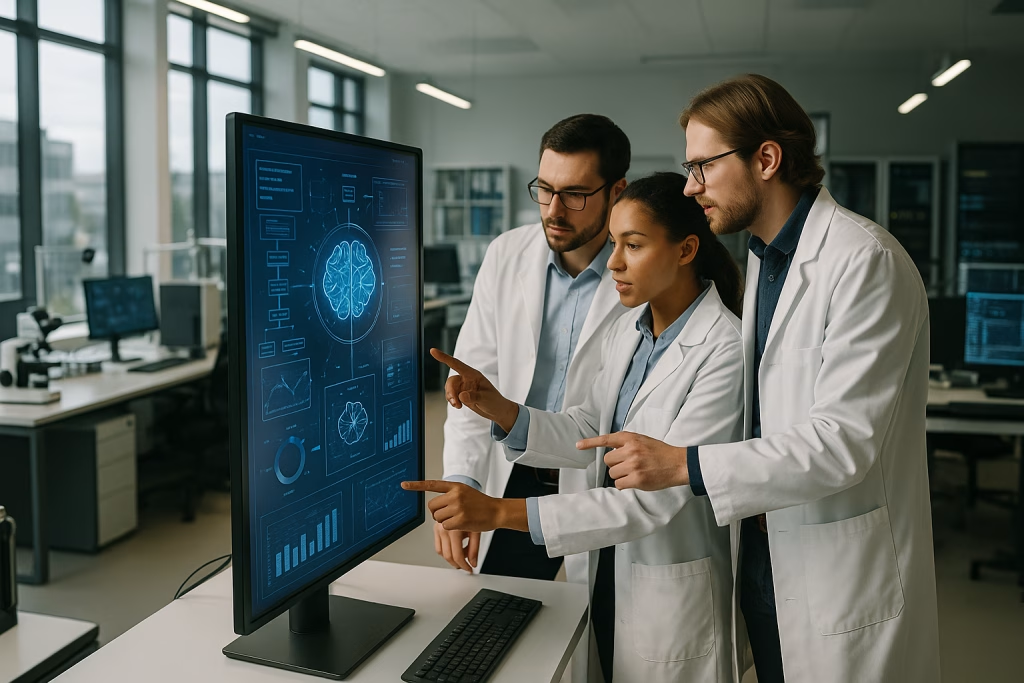
Third-Party Testing Strengthens AI Safety Through Collaboration
I’ve watched the conversation around artificial intelligence safety shift from the halls of academia to the nerve centres of global enterprise. Nowhere is this more evident than in the way leading organisations have started working hand-in-hand with outsiders, bringing third-party expertise into the core of their safety routines. Today, I want to guide you through how robust partnerships and external testing are making AI not just smarter, but – crucially – safer for everyone.
The Pillars of External AI Safety Testing
At the heart of all sound safety practices lies the willingness to challenge our own assumptions. Personally, I’ve always been rather sceptical of in-house-only audits; there’s a risk, isn’t there, of seeing only what you expect? That’s where third-party testing steps in as a balancing force. In the context of advanced AI models, collaboration with external experts doesn’t just catch what the internal team might miss – it shapes a whole new culture of openness and learning.
1. Independent Laboratory Evaluations
- Specialised testing: Independent labs go beyond cursory checks. They deploy rigorous protocols across sensitive domains, including biosecurity and cybersecurity, where stakes run especially high.
- Early access: Trusted partners often receive what’s referred to as a ‘bare’ model – stripped of normal guardrails – allowing them to probe the AI’s absolute boundaries.
I’ve seen first-hand how this approach can quickly highlight blind spots, or even spark that slightly uncomfortable realisation about the limits of our own knowledge. Honest, it’s humbling – and wildly beneficial.
2. Methodological Reviews by Domain Experts
- Audit of the process, not just the outcome: Domain specialists inspect not only the raw results of internal tests but also how those tests are designed. They scrutinise the underlying logic, which sometimes uncovers embedded assumptions or hidden flaws.
- Resource efficiency: External review is especially vital when duplicating complex in-house studies would be costly or impractical.
To my mind, inviting this sort of scrutiny is a sign of confidence and real maturity. There’s an old British saying that comes to mind: “Many hands make light work,” although in this case, perhaps, “Many minds spot hidden dangers.”
3. Domain-Specific ‘Red Teaming’ and Scenario Testing
- Real-world challenges: Experts with deep knowledge of a vertical (like medicine, law, or finance) are let loose on the newest iterations of a model. They try their utmost to ‘break’ it in ways that reflect actual risk scenarios.
- Feedback beyond the checklist: These partners aren’t just ticking boxes; they document how systems react, offering nuanced, experience-laden perspectives. This is the antidote to overconfidence that sometimes creeps in when a team’s been staring at the same algorithms for far too long.
Over the years, I’ve come to appreciate how red teaming pushes boundaries – not just of the tool in question, but of our imagination about what could go wrong. It might sound a bit dramatic, but in the world of AI safety, a little imagination can save a great deal of trouble down the road.
Transparency and Privileged Access: Openness as a Strategy
Let’s be honest – openness has become something of a buzzword lately, but in critical safety contexts, genuine transparency goes much deeper. Top-tier AI organisations frequently grant their external partners privileged access to unreleased models, including those not yet fitted with their full suite of safety controls. This isn’t just generous; it’s strategic.
- Unrestricted model versions: Partners are sometimes allowed to test the most ‘raw’ versions. This means they can explore the absolute fringe cases – the edge-of-the-envelope scenarios where trouble is likeliest to emerge.
- Full disclosure of results (within reason): When the chips are down, these testers can even publish their findings, after a customary period of checking for confidential data or proprietary techniques.
Frankly, I suspect this degree of candour stems not just from altruism, but from the hard-earned realisation that reputational trust in tech is a fragile thing. If an organisation is caught hiding skeletons, the fallout can be brutal – not only for them but for the public at large.
Coordination with Safety Authorities and Concrete Outcomes
Recent years have brought a wave of collaboration between AI companies and dedicated public sector outfits that monitor and analyse emerging risks. In some cases, this has led to visible improvements in both the models themselves and the broader systems they underpin.
Waves of Rigorous Testing
- Test–fix–retest cycles: External teams identify weaknesses, internal teams roll out targeted improvements, and then it all starts anew. This iterative rhythm continues until a satisfactory baseline of safety is reached.
- Scenario-based stress testing: In especially sensitive domains (think biohazards, for example), select safety restrictions are deliberately relaxed to test the AI’s response to hostile or manipulative input.
If it all sounds a bit painstaking, well – it is. But when I hear, say, a public authority has spent weeks poking at a supposedly secure model and found something even the creators missed, I know the system’s working as intended. “Slow and steady wins the race,” as my gran used to mutter, and in safety, haste often leads straight to the headache of costly recalls or security breaches.
Challenges and Controversies: The Flip Side of Acceleration
Not everything about AI safety collaboration is rosy, of course. There are persistent critics who worry that external review periods for the most complex models have shrunk dramatically. Where once testers might have enjoyed months to probe a new system, now – in some cases – they’re given less than a week.
- Time constraints and resource bottlenecks: Tight commercial timelines can lead to rushed evaluations, which, in my experience, is a recipe for oversights and anxiety.
- Information asymmetry: Because companies control what’s made available for testing and which results are released, there’s legitimate concern over cherry-picking. This lack of outside verification can cast a long shadow over claims of security.
- Regulatory catch-up: Lawmakers and watchdogs sometimes struggle to keep pace with the AI sector’s furious innovation cycle. There’s a palpable sense that oversight mechanisms just haven’t kept up.
I’ve chatted with a few researchers over the years who bemoan how quickly a promising audit can be curtailed by the commercial drive to launch. Their gripes ring true for me – after all, quality control in any industry with real risk should never be on a stopwatch.
Tools for Transparency: Auditable and Open-Sourced Models
One promising answer to these pain points lies in the creation of specialised tools designed for auditability and independent oversight. These aren’t just models that deliver verdicts – they lay bare their internal logic, making it easier for people like you and me (well, those of us with the patience to dig) to spot errors or potential dangers.
- Classification models with explainable outputs: These next-gen tools show their workings, so external reviewers can see not just what was flagged as harmful, but why. For anyone who has ever been stuck deciphering a black-box system, the difference is night and day.
- Open access for the research community: By making these tools widely available, companies encourage interested academics and watchdogs to poke around, replicating findings or mounting their own probes. That’s a far cry from the old ‘trust us, we’ve tested it’ routine.
I must say, it’s a refreshing wind of change compared to how things used to be. Looks like we’re finally moving past the “marketing promises” stage and into something a bit more substantial – at least, we hope so.
Industry Impact: A New Benchmark for AI Responsibility
None of this happens in a vacuum. As companies beef up their journey towards transparency and external verification, industry-wide standards slowly begin to crystallise. You’ll notice shifts in business norms – with an emphasis on risk assessment pathways, the credentials of external testers, and disclosure practices that let outsiders tell the story as it is.
- Rising expectations around disclosure drive a ‘race to the top’, rewarding those transparent enough to admit both strengths and weaknesses.
- Competitive pressure ensures that, over time, corners cut on safety tend to come to light – often via third-party whistleblowing, if not direct testing.
From my desk, I’ve noticed that clients and partners are gradually becoming more demanding – and rightly so. Whether it’s vendors or regulators, few have patience these days for mystery meat algorithms or vague pronouncements about “rigorous internal vetting.” The mood now calls for detailed, auditable processes, and, honestly, that’s the way it should be.
The Tug-of-War: Speed vs. Safety
This, I’ll confess, is where the rubber really meets the road. Despite all public commitments to doing things ‘the right way,’ there’s always that inner tension between staying ahead and staying safe. When push comes to shove, financial incentives have a nasty tendency to outpace cautious optimism. It’s not a villain narrative, just basic economics at play. Real responsibility comes down to the willingness to listen – really listen – to external voices and follow up with concrete improvements.
Practical Recommendations for Building a Safer AI Ecosystem
If you’re involved in the AI sector, or even just keeping a wary eye on its growth, these shared lessons offer a practical sketch for bolstering your own safety posture. Let’s break down some takeaways you might want to consider for your team or organisation:
- Secure independent expertise early: Don’t wait until the eleventh hour to involve outside testers; loop them in as soon as the earliest prototypes become viable for evaluation.
- Audit the audit: Make sure your safety reviews are themselves subject to outside challenge. This meta-level scrutiny might catch that last 1% of danger you’d never anticipate on your own.
- Prioritise explainability in your toolchain: Open-source, auditable models are worth their weight in gold. Not just for current credibility, but for the ongoing education of your own team (and, one hopes, your customers).
- Build in time for deep review: Don’t fall for the temptation of a quick launch cycle if it means shaving off days or weeks from the critical phase of external stress testing.
- Develop a clear communication protocol: Ensure findings (even uncomfortable ones) make it to executive decision-makers, and that responses are logged and transparent to all stakeholders.
I’ve lost count of how often small oversights snowballed into major headaches precisely because no one felt comfortable raising their hand. A little openness goes a long way – and it really is cheaper in the end.
The Human Factor: Culture and Commitment
You can buy tools, you can rent expertise – but, in my experience, you can’t fake a culture of safety. The companies that thrive over the long run are those where everyone, from top brass to the most junior engineer, is encouraged to ask “What if?” and has the support to follow up when something feels off.
- Reward scepticism: Celebrate the folks who spot issues. Don’t treat them as naysayers; see them as the canaries keeping your coal mine habitable.
- Share successes and failures: A quiet lesson never taught anyone else. Make your stumbles visible, and you’ll help the whole industry step a little more carefully.
Maybe that sounds a bit rose-tinted, but experience tells me – the more you invest in an honest culture today, the fewer regrets you’ll have tomorrow.
Emergent Trends and What Lies Ahead
So, where does it all point? The growing emphasis on third-party testing marks a shift towards frameworks that actually incentivise safety rather than merely mandate it. Over the next few years, those who lead the charge in open collaboration, clear reporting, and readiness to absorb external wisdom are likely to shape the standards everyone else follows.
- Pressure for public reporting: Stakeholders are increasingly pushing for the unvarnished truth about what’s risky and what’s not – and for independent voices to be heard over the corporate din.
- Gradual standardisation of testing protocols: Shared templates and datasets for evaluation, combined with reference groups drawn from across academia and industry.
- Recognition of the limits of self-policing: While trust is important, tangible accountability measures are now an expectation, not an afterthought.
Only time will tell whether these commitments stick in the face of commercial headwinds. But, speaking personally, I take heart every time I see a business go above and beyond, not just because they’re legally required, but because it’s the right thing to do.
Key Takeaways for the Forward-Looking Professional
As someone who’s spent years in the trenches of digital safety and strategy, I’ve seen first-hand that breakthroughs don’t come from genius alone. True, sustainable progress comes from surrounding yourself with people who aren’t afraid to challenge you. In the fast-moving world of artificial intelligence, where risks hide in plain sight, third-party testing isn’t just a best practice – it’s close to non-negotiable.
- Don’t underestimate the value of outside perspective, especially for complex and high-impact technologies.
- Embrace the sometimes uncomfortable discipline of making results public and learning from outside scrutiny.
- Invest in relationships with domain experts; their lived experience will spot what your most talented coders can’t imagine.
- Keep an eye out for emerging tools and processes that put explainability and auditability first.
- Be willing to let safety trump speed. It’s rarely a fashionable stance in quarterly reviews, but it’s the one that stands the test of time.
Final Thoughts: Towards a Culture of Scepticism and Openness
There’s no getting away from the fact that building safe, trustworthy AI is a marathon, not a sprint. For all the technical pyrotechnics and proud product launches, I find a quiet satisfaction in watching teams celebrate when an external reviewer finds a flaw—because it means the process, harsh as it sometimes is, is working.
Every time I see seasoned professionals open the door for scrutiny, share both victories and mistakes, and remain open to real back-and-forth with testers from beyond their four walls, it feels like a small step in the right direction. That’s the sort of humility and backbone that has always inspired me, and I suspect, will inspire the next generation of AI leaders as well.
If you want to sleep soundly knowing your AI-powered systems are as safe as they can be, surround yourself with people who see things differently – and give them the time and tools to do their best work. After all, as any good Brit will tell you, “forewarned is forearmed.”