
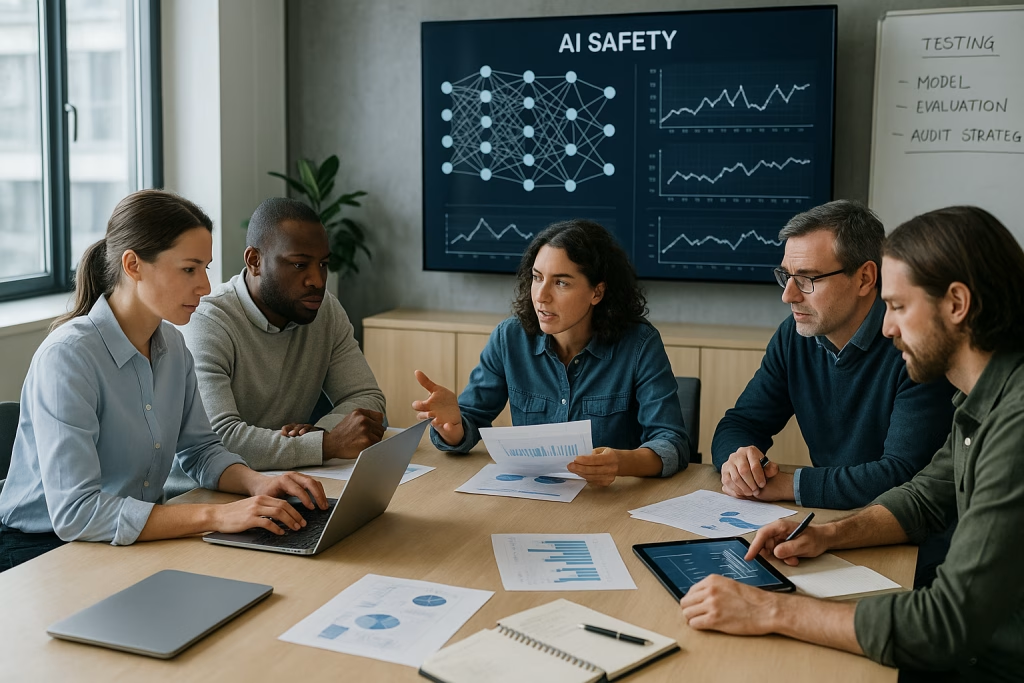
Third-Party AI Testing Strengthens Safety and Trust Ecosystems
Speaking from my own experience with AI-driven business automation and as someone immersed in the world of advanced marketing, I’ve seen firsthand just how quickly artificial intelligence blossoms – sometimes at a pace that bends the very fabric of organisational risk management. Yet, for all its promise, AI’s real-world impact teeters on a razor’s edge of opportunity and concern. That’s precisely where third-party testing steps in, serving as a steady hand to guide progress along the bumpy road to trustworthy innovation.
The Rationale Behind Independent AI Safety Testing
Let me be clear: third-party testing isn’t just a matter of regulatory checkbox-ticking—it’s a living, breathing element within any mature AI safety strategy. At Marketing-Ekspercki, I’ve seen how independent, external scrutiny offers a sense of perspective that simply can’t be replicated internally. Frankly, it’s easy for any tech team to become just a bit too comfortable with its own way of doing things. We all get a tad myopic now and then, don’t we?
- Unbiased Insight: Outsiders bring fresh eyes, free from internal biases and assumptions that naturally creep in.
- Domain-Specific Knowledge: External experts may possess industry or academic knowledge missing within an organisation’s core team.
- Alignment with Public Good: Transparent, accountable tests allow society, not just companies, to evaluate AI risks and benefits.
There’s a certain English wit in saying, “It pays to have someone competent poke holes in your work, before the world does it for you.” And truly, that’s the heart of robust third-party testing for AI safety.
Collaboration Models Between AI Developers and External Experts
Over the years, I’ve had the privilege of collaborating closely with both commercial AI developers and independent research groups. These partnerships have evolved in fascinating ways, each one weaving itself into a much bigger picture – a tapestry of safety practices that goes beyond superficial audits.
Structured Penetration Testing and Open Invitations
Some of the most valuable insights emerge from highly-structured “red team” exercises, where trusted experts attempt to outwit, mislead, or otherwise deconstruct AI systems under controlled conditions. What stands out for me is how bold the best programmes are in inviting outside scrutiny:
- Early Access Testing Programmes: Select independent researchers are granted access to unreleased models and tools, giving them the chance to identify vulnerabilities and edge cases before product launch.
- Cyclic Penetration Tests: Specialized security professionals deliver scheduled, sometimes surprise, attacks in order to map out systemic weaknesses and potential exploits.
I’ve seen how these strategies allow companies to preview how well their “safety nets” hold up when faced with unconventional risk. Sometimes, the results are humbling – but always helpful. After all, it’s better to have bruised egos than a scarred reputation.
Liaisons with Government and Standards Bodies
The plot thickens when public sector institutions like AI safety institutes step into the ring. I can attest that such partnerships provide not only authority, but also a much-needed bridge between fast-moving tech and the slower churn of public oversight.
- Developing Shared Risk Frameworks: By working hand-in-glove with regulatory bodies, organisations help set clear benchmarks that everyone – developers, investors, regulators – can rally behind.
- Wider Ecosystem Protection: The presence of external, often governmental, experts ensures that community, consumer, and even national interests are respected, not swept under the rug.
Frankly, I sometimes wonder how on Earth we’d keep up with AI’s breakneck momentum if not for cooperative models rooted in transparency and mutual challenge.
Methodologies: How Do Third-Party AI Security Tests Work?
Now, here’s where things get properly meaty. I thrive in environments where rigorous procedure meets creative problem-solving – and, in my view, the best third-party testing efforts blend ironclad process with a dash of investigative curiosity.
Key Steps in the Independent Testing Process
- Disclosure & Independence: It all starts with trust. The identities, backgrounds, and degrees of affiliation of all external testers must be documented and disclosed. No cloak-and-dagger antics here, just clear accountability – and that’s something we can all appreciate.
- Replicability: Every test protocol must be engineered so that others can repeat the steps, verify the findings, and potentially spot gaps the original team missed. I see this openness as the gold standard for scientific practice.
- Data Transparency: Qualified testers typically gain wide-ranging access to logs, datasets, and internal system states. That level of transparency is essential if real issues are to be surfaced, rather than glossed over.
- Publication Rights: Independent experts retain the right to publish their results – warts and all – free from censorship or foot-dragging by AI system developers.
In my career, I’ve noticed that organisations often struggle at first with the idea of opening their “digital kimono,” so to speak. Yet, it’s precisely this openness, sometimes uncomfortable, that underpins trust. When external findings become accessible to both regulators and the wider public, everyone becomes better equipped to gauge what’s safe, what’s risky, and where urgent attention is needed.
“Red Teaming” – The Art of Proactive Challenge
Ask any experienced security professional, and they’ll likely grin when you mention red teaming. This practice introduces simulated adversarial attacks on AI models, mimicking real-world threats or simply pushing systems to breaking point.
- Social and Technical Manipulation: Red teams explore how models cope with misleading prompts, biased datasets, or attempts to circumvent safety guardrails.
- Extreme Scenario Analysis: By unleashing edge-case queries and sophisticated exploits, testers shine a light into AI’s darkest corners, hunting for rare but potentially catastrophic failures.
- Biosecurity and Ethics: Increasingly, red teams are asked to focus on “dual-use” risks – could a seemingly innocuous tool be repurposed, say, for disinformation or even bioengineering abuse?
From what I’ve witnessed, these exercises unearth not simply technical bugs, but whole new categories of risk – the sort you’d miss by following a checklist.
Transparency in Test Results: Why Publication Matters
Once, I recall a situation where a promising machine learning product floundered simply because its developers tried to keep negative external findings under wraps. Predictably, word got out anyway, and the company’s credibility took a pounding.
Publication Norms and Practices
- Independent Publication: Modern best practice gives independent testers their voice. No filter, no spin – just raw conclusions and evidence.
- Accessible Reporting: Organisations increasingly issue plain-language summaries and full technical reports, ensuring that both laypeople and specialists can interpret the findings.
- Raw Data Availability: When possible, releasing sanitized datasets and activity logs empowers the broader research community to reproduce results.
There’s an old British saying: “The sun never sets on the truth.” That’s the philosophy I try to carry into every AI project I touch. It’s not about inflating reputations – it’s about holding the field to a standard that endures.
The State of Play: Limitations and Friction Points
Here’s where I need to take off the rose-tinted specs for a moment. Despite all the progress, the world of third-party AI testing remains a hotbed of both opportunity and squabbles – let’s call a spade a spade.
Resource Constraints and Time Pressure
- Shrinking Timelines: Many of the AI industry’s biggest launches are now measured in weeks, not months. In my own dealings, I’ve seen evaluation windows, once luxuriously expansive, become dangerously narrow.
- Skeletal Teams: Expertise isn’t cheap. Quite often, both internal and external testers operate under tight budget and staffing constraints, which can sap thoroughness.
- Breadth vs. Depth: The sheer scope of modern AI models means testers must make hard calls between comprehensive coverage and deep-dives into specific issues.
For any aspiring product manager, it’s a harsh reality—sometimes, the “move fast and break things” ethos leaves little space for the kind of methodical testing that could avert a future headline-grabbing disaster.
Influence and Editorial Control
- Selective Transparency: There’s often a temptation behind closed doors to “curate” which findings see the light of day.
- Test Scope Boundaries: Some companies set tight parameters around what external experts can examine, effectively blunting any real challenge.
- Public Testing Leaks: Occasionally, products turn up in the wild before internal vetting is complete—leading to uncontrolled, sometimes premature exposure.
If I had a penny for every time a promising bit of tech got scuppered by a PR gaffe, I’d be writing this from my Caribbean villa, not an office in rainy England. Joking aside, though, public trust hinges on authenticity—people can sniff out half-baked assurances a mile away.
The Case for Persistent, Broad-Spectrum Independent AI Auditing
Based on my own observations over the years, I’d argue that the “third pair of eyes” principle is more vital now than ever. As AI systems seep into more corners of industry, government, and daily life, the downsides of misplaced confidence only grow.
Benefits for the Ecosystem
- Public Interest Protection: Third-party testing helps detect “unknown unknowns”, safeguarding the broader community from consequences that aren’t always obvious at first glance.
- Scientific and Regulatory Confidence: Reliable, repeatable results foster consensus among stakeholders, including regulators, academia, and business.
- Cross-Disciplinary Learning: Diverse testers bring new analytical tools, from biosecurity checklists to social bias frameworks, which enrich the collective approach to AI risk.
No rose comes without thorns, as the saying goes. Occasionally, I’ve seen external reviewers miss key risks entirely, or worse, become so adversarial that trust between them and development teams melts down. Yet, these are growing pains shared by every meaningful process of peer review.
The Cultural Shift Toward Transparency
Let’s be honest – inviting outside scrutiny requires a bit of “stiff upper lip”. But the most resilient organisations, in my experience, are those willing to air their dirty laundry. When results – good, bad, or ugly – are routinely shared, the industry as a whole levels up. Regulators, too, can base interventions on solid ground, rather than rumour or panic.
Improving the Third-Party Testing Landscape: Practical Next Steps
As someone with a foot in both technical and commercial camps, I’m convinced there’s room for a step-change in how the AI world approaches independent safety evaluation. Here’s my personal wish list – drawn from projects that worked and a few that didn’t.
- Tighter Coordination with Public Institutions: Regular, structured collaborations not just with commercial partners, but also academic consortia and government agencies, can foster both consistency and accountability.
- Transparent Access to Test Environments: Open up not just sandboxes, but also “live fire” production environments where it’s safe to fail without risking real-world harm.
- Frequent, Non-Censored Results Publication: Set an industry bar for speedy, unfiltered reporting. Nobody wants to wait months for conclusions that have already gathered dust.
- Encouragement for Whistleblowing: Make it socially and professionally acceptable for experts to raise the alarm – anonymous if need be, but always protected.
- Proactive Community Building: Foster global communities of testers, skeptics, and critics – folks willing to kick the tyres out of sheer curiosity or civic duty.
Prioritizing Both Technical and Ethical Risk Domains
Given the pace of AI innovation, responsivity is paramount. From what I’ve seen, too many test suites still focus on old-school “does it crash?” checks at the expense of broader ethical risks – bias, disinformation, unintended dual use. It’s time to broaden the lens.
Concluding Reflections: Building a Trustworthy Future for AI
From where I sit in the industry, it’s abundantly clear that the future shape of AI – its place in our society, commerce, and culture – rests on our collective willingness to invite scrutiny. At its core, third-party testing represents far more than just a rubber stamp for compliance. It’s an ongoing conversation, a dynamic partnership, and a messy, often quarrelsome, but ultimately indispensable part of building trustworthy technology.
Every effective process I’ve witnessed, every course correction prompted by an awkwardly timed external audit, has played its part in fostering the only reputation that counts: one built on openness, humility, and a shared stake in public benefit.
So, whether you’re a technical lead in a global AI firm, a policy wonk, marketer, or simply someone with a lively interest in the technologies shaping your world, remember – the truest safety net isn’t woven by insiders alone. It’s patched together by a chorus of voices, each one challenging, provoking, and, just occasionally, saving us from ourselves.
Useful Resources and Further Reading
- AI Safety Guidelines: Look up position statements and reports from a range of government and industry bodies addressing best practices in AI testing.
- Red Teaming Playbooks: Seek practical how-to documents published by academic consortia and independent research groups.
- Case Studies: Review well-documented case studies, especially those that flag the value (and limits) of independent auditing.
- Forums and Communities: Join active online spaces where practitioners, critics, and enthusiasts debate current AI safety news and audits.
If you’re after more detail, or want to connect with those at the sharp end of this work, just drop a line on industry forums or professional networks – there’s always someone, somewhere, willing to share wisdom over a cuppa.
In the end, collective vigilance is the price of trustworthy progress. Here at Marketing-Ekspercki, I’ll keep championing responsible AI – and, just as importantly, the tireless, sometimes exasperating, work of those who test its limits.