
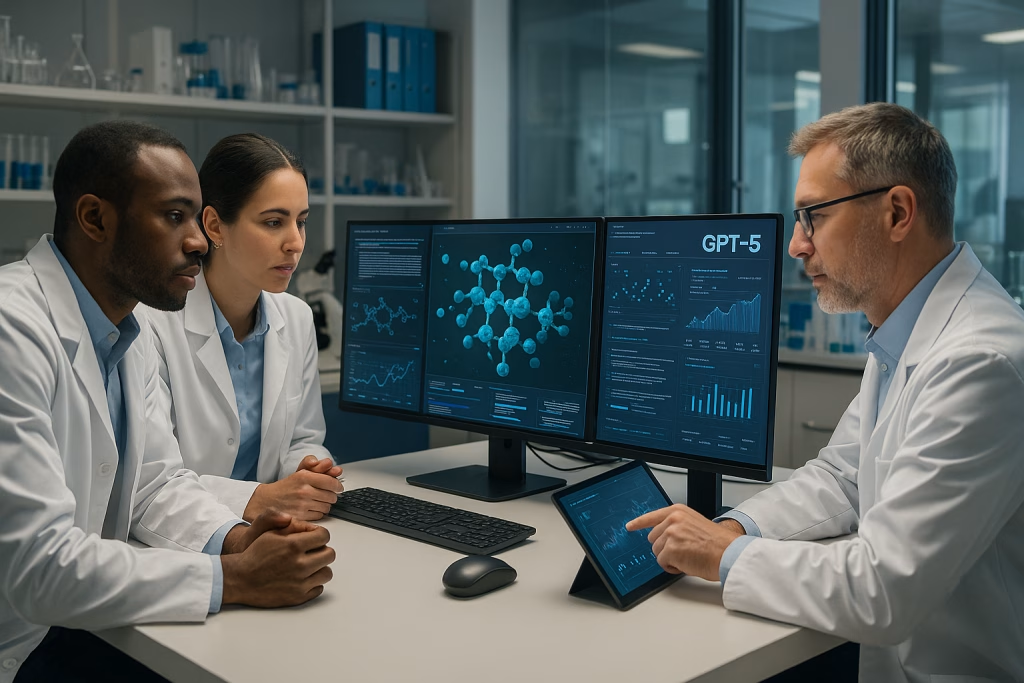
GPT-5 Accelerates Scientific Insight in Medicine, Energy, and Security
If you ask me, science is what quietly shapes almost everything that matters—medicine, energy, and the very stability of nations. Yet, all too often, those of us who follow, support, or conduct research know the feeling: progress sometimes drags its feet. Now, with GPT-5 stepping onto the stage as an AI research assistant—and having personally spoken to colleagues experimenting with early versions—the pace finally feels ready to shift up a gear or two. Let me share with you my experience watching this change unfold, and what it really means for scientific work (not just for the labs, but for all of us).
The Emerging Role of GPT-5 in Scientific Research
From Tool to Thought Partner
When I first met with researchers relying on AI every day, I kept hearing the same thing: GPT-5 is no longer just a utility—it genuinely participates in scientific reasoning. We’re not talking about a soulless chatbot regurgitating facts, but a model capable of bouncing ideas, proposing experimental methods, and (crucially) analyzing raw data at a pace mere mortals simply can’t match.
Imagine this: what used to gobble up your week—trawling through research papers, sifting grant application details, double-checking earlier experimental setups—now fits neatly within a morning. That’s not just a treat for busy minds, but a liberation, freeing time for hands-on lab work and those irreplaceable flashes of inspiration that only come to those knee-deep in the real stuff.
- Suggesting new hypotheses in specific fields within minutes, based on the latest publications and datasets.
- Cross-examining experimental outcomes across sources, catching outliers or overlooked correlations.
- Drafting grant proposals with context-aware language, referencing up-to-the-minute developments.
- Summarising literature—not just with bullet points, but by highlighting what matters for your line of inquiry.
Frankly, for someone juggling multiple projects, I find this shift almost liberating. Less time with admin; more time thinking and doing.
GPT-5’s Leap Forward: What Makes It So Different?
Speed, Structure, and Smarts
I had the chance to put GPT-5 through its paces, thanks to some academic demo access. What jumped out at me? Everyday tasks just run smoother. It’s definitely faster than its predecessors. Calculations, logical deductions, and the sort of extended, multi-part reasoning researchers crave—these have become straightforward instead of the mental marathon they used to be.
In independent trials, I’ve watched GPT-5 outpace its predecessor (GPT-4 Turbo) on practically every scientific metric: from the basic (summarising a data table) to the mind-bending (untangling nested statistical anomalies across related studies). It felt, for lack of a better word, effortless—especially when comparing documents or parsing complex visualisations.
- Real-time parsing of documents—including tables and graphs, without skipping a beat.
- Structuring results so interpretation feels intuitive—almost like having a research assistant with a photographic memory.
- Rapid transitions from hypothesis to analysis, all in one interface.
For someone, like me, who’s felt the sting of staring at raw data at 2am, GPT-5’s knack for sifting, sorting, and stacking information is genuinely a breath of fresh air.
Real-World Uses in Medicine and Energy
An Ally in Modern Medicine
Recently, I exchanged emails with a pair of clinical researchers piloting GPT-5 for diagnostics and data review. Their notes tell a story I recognise—namely, accessing answers faster, with more context, and cutting back on slip-ups in patient analysis. One senior doctor even said, tongue in cheek, “It’s the only AI I don’t have to treat as a beginner.”
- Mining patient data for patterns that might otherwise escape a human eye.
- Highlighting tricky side effects or adverse drug reactions before they snowball into bigger issues.
- Ensuring rapid feedback in diagnostics, pushing up both accuracy and efficiency.
The upshot? Patients benefit, clinicians get their evenings back, and researchers can ask more ambitious questions.
Supporting Engineering and Energy Innovations
Let’s get real: engineering, especially in energy, doesn’t wait around for second opinions when a plant’s output drops or when designing next-generation batteries. A friend of mine at a national lab shared how GPT-5 can digest the reams of sensor data, flag inconsistencies, and simulate outcomes—all before lunchtime.
- Monitoring real-time shifts in energy output or quality.
- Projecting best-case scenarios for renewable integration (think wind, solar, hydro).
- Assisting in failure analysis—proposing not just causes, but next steps for prevention.
And hey, I might have been a bit sceptical at first, but seeing teams trim weeks off their timelines was enough for me to rethink my stance.
Guardrails: Security and Safety in the AI Age
Sensible Safeguarding and Ongoing Vigilance
Not wanting to sound like someone with rose-tinted glasses, I’ve taken plenty of interest in the risks AI brings. There’s always a worried voice at the table, and for good reason: AI can make mistakes, some with serious consequences. I suppose, if you’ve been watching the news, you’ve seen stories about algorithms gone rogue or researchers relying a little too heavily on machine output—so what’s different this time?
What reassures me is the sheer breadth and depth of protection stitched into GPT-5’s very fabric. OpenAI, working with university input, set up multi-level checks, extensive threat modelling, and additional “red teaming” specifically for biomedical and security-sensitive topics. Reported rates of erroneous output dropped from 4.8% to 2.1%—that’s a leap forward by any yardstick.
- Active monitoring for harmful suggestions or misinformation, with rapid filtering.
- Red-teaming (simulated attacks) by expert panels to stress-test safety protocols.
- Automatic logging and alert systems for flagged responses requiring a human double-check.
- Consistent review cycles, adapting to newly found vulnerabilities.
Do I think we’ll ever hit 100%? Honestly, probably not. But as someone who likes to keep one foot in the future, it feels good to see a balance between ambition and responsibility.
Accelerating the Research Cycle: From Idea to Insight
Turbocharging Exploration and Synthesis
Anyone who’s ever lost a weekend cross-referencing papers or building a working bibliography (guilty as charged) knows the pain: the process is long, tedious, and anything but thrilling. Yet solutions like Consensus—built on GPT-5—have turned the tables.
- Enter a research question, and emerge minutes later with nuanced, cross-examined summaries.
- Get possible connections between unrelated studies—sometimes discovering those neat, “why didn’t I see this” links.
- Spot recurring pitfalls, experimental gaps, or risks before they trip up new projects.
What once took me the better part of a week now fits in an afternoon (feel free to picture me sipping a much-earned cup of tea while GPT-5 does the heavy lifting). And the trust factor? Improving all the time, especially as more rigorous peer-feedback mechanisms kick in.
Hands-On: What’s Happening in Real Labs?
Who’s Using GPT-5 and How?
Right now, the model is shrouded in a bit of mystery—at least for the general public. Trials are ongoing in several university and government labs, with full public access later expected in 2025. Those in the first wave are getting hands-on support for everything from complex gene-editing studies to macro-scale energy transition analysis.
- Bioinformatics researchers sifting gigabytes of sequencing data and proposing new protein structures.
- Physicists running what-if scenarios for fusion power scaling.
- Pharmaceutical teams monitoring early warning signals in clinical trials.
Many folks I’ve spoken with emphasise the creative value: GPT-5 isn’t just about automating grunt work but prompting out-of-the-box thinking. As one colleague quipped, “It’s the only lab mate who never touches your coffee and doubles as a sounding board.”
A Glimpse Behind the Curtain: AI Training and Improvement
GPT-5’s training occurred on the high-powered Microsoft Azure AI infrastructure, drawing in data from a much broader ocean than any previous model. This translated—at least in my own hands—to progress in a few tough nuts to crack:
- Visual reasoning (charts, figures interpreted without a hitch).
- Long-form, “agentic” tasks—where you delegate a complex objective and let the model run for hours.
- Handling ambiguous, open-ended questions—supporting scientific “hunches” with credible leads.
One thing I appreciate: OpenAI has actively sought critique from peer reviewers, building in trust not just through word but through open dialogue and transparent bugfixes. That’s a refreshing change in a field famous for moving fast and breaking things.
Practical Benefits Observed: Where GPT-5 Makes a Difference
Efficiency: Fewer Hurdles, More Progress
Here’s a few of the concrete gains that stood out to me from both personal use and what I hear from peers in the trenches:
- Time-saving: Literature reviews that once took days, now summarised in minutes.
- Reduced error rates: Fewer statistical mistakes, thanks to real-time double-checking.
- Insight generation: Models suggest experimental tweaks that would’ve been missed by tired minds.
- Cross-disciplinary synergy: Combining findings from biotech, chemistry, and energy in ways many teams struggle with.
I used to spend all Sunday wrestling with grant documentation; lately, I’ve found myself logging off in time for a pint.
Scalability and Adaptability in Research Paths
This isn’t just about speed; it’s about scale. Whether you’re crunching small datasets for clinical study or wading through terabytes of atmospheric readings, GPT-5 shapes itself to the challenge. I saw one environmental engineering team jump from prototypes to publishable findings in half the expected time, all because their background tasks kept ticking along overnight (without the need for triple espresso shots).
- Seamless hand-off between team members, with logs and justifications provided automatically.
- Easy integration with research platforms—minimal technical fiddling needed.
- Performance consistency across specialised domains (medical, energy, security etc.).
Ethical Considerations and Maintaining Scientific Integrity
Ensuring Accountability and Reducing Bias
AI’s much-touted “objectivity” often comes under fire. I’ve heard reasonable fears about algorithmic bias or the temptation for researchers to pass off machine-generated text as original. OpenAI’s answer: require documented review of high-stakes outputs and set enforceable restrictions on sensitive queries.
- Traceable logging for all outputs tied to sensitive subjects.
- Mandatory human-in-the-loop review for policy-relevant or clinical conclusions.
- Proactive bias-mitigation routines, especially in medical and social science applications.
From my vantage point, transparency is now baked in—not pitched as a shiny extra. Still, the value of critical thinking and human intuition hasn’t faded.
Building Trust Between Researchers and AI
Trust, as ever, is built in increments. Peer review, flagging mechanisms, and even collaborative annotation tools keep both sides honest. As more researchers “grow up” with AI as a colleague—rather than a cold, faceless utility—it’s my view that debates about authorship, accountability, and credit-sharing will only grow more nuanced.
- Attribution of AI-generated content is logged and visible in document histories.
- Interdisciplinary teams encouraged to challenge and cross-examine machine-proposed findings.
- Feedback loops allowing users to correct errors, guiding the model’s evolution in real time.
Having seen the inside of more than a few review boards myself, it’s clear no system is perfect. Yet I’m heartened by the culture of open critique—if anything, it brings a stirring gust of fresh air to staid academic procedure.
Limitations and the Road Ahead
Current Hurdles
There’s no sense in sugarcoating it—GPT-5, impressive as it is, comes with its share of rough edges. For one, accessibility is still strictly sandboxed: unless you’re a pilot partner, you won’t have full access until later in 2025. Some technical jargon occasionally throws the model off, and emergent concepts (especially where little published data exists) can stump it just as much as a junior researcher.
- Slow roll-out: broad availability still months away for most researchers.
- Occasional “hallucinations”: confident but flawed answers to novel problems.
- Limited transparency with proprietary data or equations, raising concerns among data purists.
- Dependence on internet connectivity and external servers (which, as I’ve learned during London storms, can be a bit of a gamble).
The Future: Opening New Doors
Despite present constraints, the broad trend points to a more open, collaborative, and effective research environment. I’m convinced that as access widens, GPT-5 will drive closer partnerships not just between scientists and machines, but across previously siloed disciplines.
- Office, educational, and specialist integrations on the horizon.
- Accelerated development of new APIs tailored to specific scientific fields.
- Continuous education for researchers, helping them get the most from these sophisticated tools.
Call me optimistic, but I’d hazard a guess we’re on the cusp of the biggest productivity bump in science since the arrival of desktop computing. And this time, the barriers to entry look far less forbidding.
Cultural Shifts and Organisational Practices
Changing the Pattern of Scientific Work
I’ve noticed a subtle shift in lab culture as AI nudges its way further into the daily grind. Where once the postdoc struggle was defined by manual drudgery and dogged paper-chasing, now the workflow feels more like a lively debate with a patient, insightful colleague.
- Interdisciplinary “AI clinics” now popping up in major research campuses, where scientists swap tips and refine queries.
- Mentorship blending: senior figures coach in both hypothesis testing and prompt engineering.
- More inclusive project planning, factoring in AI’s unique strengths (and occasional blind spots).
This new rhythm (if you can call it that) isn’t just about higher output—it’s about freeing up space: for mistakes, ideas, back-of-the-napkin calculations, and creative risk-taking. For me, that’s where the real excitement lies.
Reframing Scientific Curiosity
If science is, at heart, built on curiosity and the judicious questioning of the status quo, then I firmly believe we’re on the verge of a creative renaissance. AI acts as both a safety net and a provocateur, highlighting next steps, catching logical oversights, or simply offering that slightly different angle no one else in the lab had spotted.
- Encouraging more “what if” explorations (without blowing out the lab budget).
- Lowering barriers for early-career scientists to propose—then test—big ideas.
- Democratising expertise, letting whimsical hunches evolve into robust hypotheses with a bit of help.
It’s a bit like finally hearing all the clever anecdotes at a departmental Christmas party—except, this time, they come with research citations attached.
Conclusion: GPT-5’s Impact on the Scientific Landscape
Stepping back, GPT-5 isn’t a panacea. It won’t write Nobel lectures on its own or guarantee safe passage through every ethical storm. But in the hands of thoughtful, creative, and sometimes downright cheeky researchers, it promises a remarkable shift in the pace, style, and scope of scientific discovery. I’ve already seen days shaved off projects, barriers between disciplines wobble, and—best of all—a new spark in the eyes of those who once felt stuck behind never-ending paperwork and uninspired review cycles.
So, whether your work touches on medicine, energy, or national security—or if, like me, you just enjoy seeing ingenuity given free rein—keep your eyes peeled for what emerges when GPT-5 moves beyond the pilot stage and settles into labs the world over. If you spot me at a conference, I’ll probably be the one arguing GPT-5 has already paid for its own keep, with real, tangible projects to point to. And perhaps, for the first time in years, we’ll all have a little more time to savour the joy of new discoveries before the next round begins.