
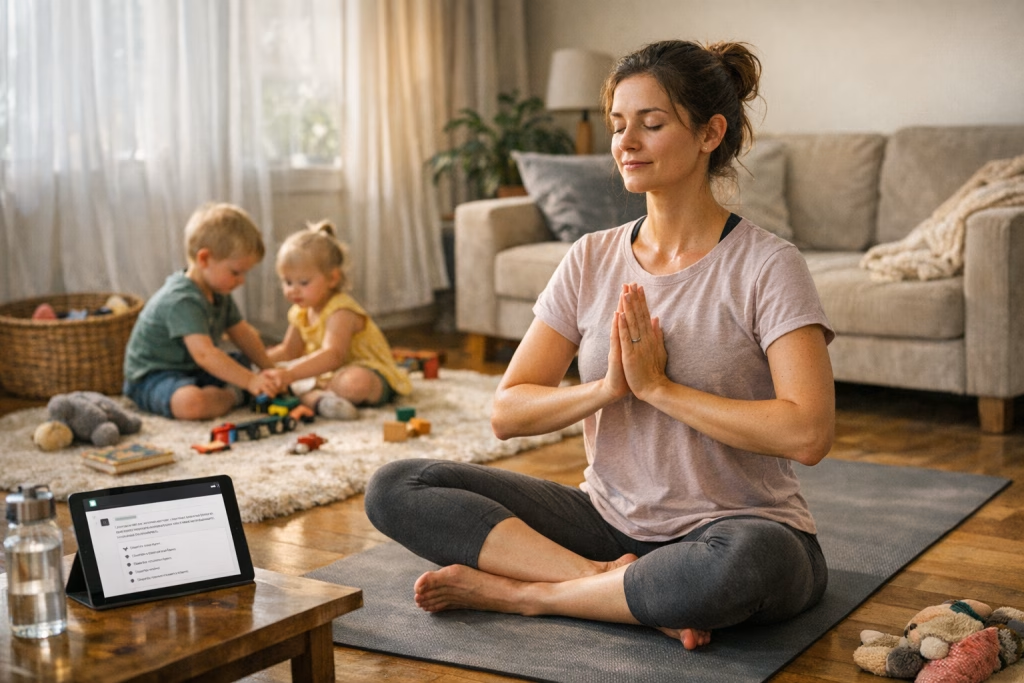
Finding Time with Toddlers Using ChatGPT for Flexible Workouts
When you live with two toddlers, your day doesn’t run on a tidy timetable. It runs on snack requests, missing socks, surprise tantrums, and that oddly urgent need to “do it myself” right when you’re trying to leave the house. I’ve worked with plenty of busy professionals through Marketing-Ekspercki, but parents of small children sit in a special category: you can plan all you like, and then real life strolls in, tips the plan upside down, and toddles away.
That’s why the story shared by OpenAI about Lauren, a mum of two toddlers who uses ChatGPT to fit flexible workouts into the unpredictable rhythms of her life, feels so familiar. It’s not about chasing a perfect routine. It’s about building something that bends without breaking. If you want to move your body, keep your sanity, and still have enough energy left to read one story at bedtime (instead of five), you need a system that works with your constraints, not against them.
In this article, I’ll show you how you can use ChatGPT to create flexible workouts, plan micro-sessions around naps and nursery runs, and keep momentum even when your day goes off-script. I’ll also share how we think about automation at Marketing-Ekspercki, because once you see how simple prompts and lightweight workflows can support your habits, you may never go back to the “all-or-nothing” approach again.
Why flexible workouts matter when you’ve got toddlers
Toddlers don’t just interrupt your schedule; they replace it. One day you’ll get a glorious 90-minute nap window. The next day, naps vanish and you spend an hour negotiating with someone who can’t pronounce “negotiating”. In that environment, rigid fitness plans tend to fail for one plain reason: they assume tomorrow looks like today.
A flexible workout approach accepts three realities:
- Your available time changes daily. Sometimes you have 8 minutes; sometimes you have 28; sometimes you’ve got nothing but a walk to the playground.
- Your energy fluctuates. Sleep disruptions, mental load, and the general chaos mean your “best effort” won’t look the same each day.
- Consistency comes from options, not rules. A plan with branches—Plan A, B, and C—keeps you moving even when Plan A collapses.
ChatGPT fits this style brilliantly because it can generate alternatives quickly, adapt to your day in real time, and help you decide what matters most when you’re tired and short on patience.
The trap: waiting for the “right time”
I’ve seen this pattern over and over: you tell yourself you’ll start exercising again once life calms down. With toddlers, that calm period can feel like waiting for British summer to become reliably sunny. It happens occasionally, but you wouldn’t plan your whole year around it.
Instead, you need a routine that works on “messy days” because, frankly, most days are a bit messy.
What the OpenAI post highlights (and why it resonates)
The source material here is short and simple: OpenAI shared a post about Lauren, a mum of two toddlers, who uses ChatGPT to find time for herself through flexible workouts that match the unpredictable rhythm of her busy life. That’s it. No grand claims. No guru narrative. Just a relatable idea: use an AI assistant to reduce planning friction and help you keep a form of self-care alive.
From my perspective, the value sits in three practical points:
- Decision fatigue is real. ChatGPT can reduce the “What should I do today?” loop that burns time and motivation.
- Flexibility keeps habits alive. AI can offer multiple workout versions based on time, equipment, and energy.
- Small windows add up. A few short sessions across the week often beat one “perfect” session that never happens.
Now let’s turn that idea into a step-by-step system you can actually use.
How to use ChatGPT to build workouts that fit your day
If you’ve ever tried to exercise with toddlers at home, you already know the headline: your plan needs to survive interruptions. ChatGPT helps most when you treat it like a practical coach who can draft options fast and adjust them based on your feedback.
Step 1: Give ChatGPT your real constraints (not your ideal ones)
The biggest mistake I see is people describing their aspirational lifestyle instead of their current one. If you tell ChatGPT you can work out for 45 minutes, five days a week, that’s what it will build. If your reality is “three unpredictable windows a week, between 6 and 20 minutes,” say that.
Try a prompt like this:
Prompt:
“Act as a practical fitness planner. I’m a parent of two toddlers. My workout windows are unpredictable: I may have 6, 10, 15, or 25 minutes. I have a yoga mat and a pair of light dumbbells. I want to improve strength and energy without exhausting myself. Build me a flexible weekly plan with options for each time window, plus a simple warm-up and cool-down.”
When I do this for myself (or for clients who want habit structure), I also add constraints like noise level (“keep it quiet while kids nap”) or impact level (“no jumping because downstairs neighbours”). ChatGPT can work with those details immediately.
Step 2: Ask for “menu-style” workouts
A menu beats a calendar when your day changes hourly. You want a small library of short sessions you can pick from, depending on the time you’ve got and how you feel.
Prompt:
“Create a workout menu with: 5-minute reset, 10-minute strength, 15-minute full-body, 20-minute low-impact cardio, and a 25-minute strength focus. Keep it realistic for a busy parent. No complicated moves. Include exercise names, sets, reps, and rest.”
Then save the results somewhere you can reach quickly—Notes app, a printed sheet on the fridge, or a message to yourself. Your future self will thank you.
Step 3: Keep a “minimum viable workout” for chaotic days
On some days, you won’t get a neat workout. You’ll get fragments: 90 seconds here, 3 minutes there. A minimum viable workout gives you a way to keep the habit intact.
Here’s what I typically recommend asking for:
- A 3–5 minute routine you can do without changing clothes
- Two levels: low energy and normal energy
- Clear rules: “Do it once and you’re done”
Prompt:
“Design a minimum viable workout for days when I’m exhausted. It must take 3–5 minutes, require no equipment, be low-impact, and still feel like I did something meaningful. Give me a low-energy version and a normal-energy version.”
This matters because consistency isn’t built on your best days. It’s built on the days you’d normally quit.
Practical workout formats that suit toddler life
Let’s get concrete. These formats work well because they tolerate interruptions and don’t require you to “get in the zone” for ages.
1) Micro-sessions (6–12 minutes)
Micro-sessions are ideal for nap-time roulette or the gap between nursery pick-up and making dinner. You can do them with bodyweight or light dumbbells.
- Structure: 30–40 seconds work, 20–30 seconds rest, repeat 2–3 rounds
- Benefit: fast, measurable, easy to repeat
Ask ChatGPT to create three micro-sessions you can rotate through, so you don’t get bored.
2) “Interruptible” strength circuits
This is my personal favourite with kids around. You pick 4–6 movements. If you get interrupted, you pause and continue later. No stopwatch drama.
- Example moves: squats, glute bridges, rows, overhead press, dead bug, plank
- Rule: finish the circuit whenever you can, even if it takes an hour in tiny chunks
ChatGPT can write circuits based on what you have at home and what feels safe for your body.
3) Walking workouts and pram miles
Some days the most realistic movement is a walk. That still counts. If you want to make it more “workout-ish,” ask ChatGPT for a simple walking structure, like intervals of brisk pace and easy pace, or hill repeats if your area has them.
Prompt:
“Create a 25-minute walking workout I can do while pushing a pram. Include warm-up, intervals, and a cool-down. Keep it safe and realistic.”
4) Mobility sessions that lower stress
Parents often chase intense workouts because they miss the feeling of “training properly.” I get it. I also know that when stress runs high, mobility work can feel like a glass of water when you’ve been living on coffee.
Ask ChatGPT for a 10-minute mobility routine geared to common parent tight spots: hips, lower back, shoulders, and neck.
Prompts you can copy and paste (and tweak)
I’m going to give you a small set of prompts that work well in real life. Keep them saved. You’ll use them more than you expect.
Prompt: daily workout decision in 30 seconds
Prompt:
“I have [8/12/20] minutes. My energy is [low/medium/high]. I have [no equipment / mat / dumbbells]. I want a low-impact workout. Give me one plan with exact steps and minimal explanation.”
Prompt: post-nap ‘quiet workout’
Prompt:
“Design a quiet workout I can do while my toddler naps. No jumping, no loud transitions. 12 minutes total. Full-body and simple.”
Prompt: toddler-inclusive session (yes, really)
Prompt:
“Give me a 10-minute workout where a toddler might climb on me. Make it safe, low-impact, and focused on core and glutes. Include cues to protect my back.”
Prompt: progression without overthinking
Prompt:
“Create a 4-week progression for my 15-minute strength workouts. Assume I can train 3 times per week. Keep the plan simple and realistic. Tell me how to progress reps or difficulty.”
Prompt: soreness and recovery
Prompt:
“I feel sore in my [legs/hips/upper back]. Suggest a 10-minute recovery routine and one gentle workout option for today. Keep it low-impact.”
How I’d set this up as a simple weekly system (without pretending life is predictable)
If you want a system that survives toddler chaos, you need two layers: a light plan and a daily decision rule.
Layer 1: a “target week” with wiggle room
I usually suggest aiming for something like:
- 2 strength sessions (15–25 minutes)
- 1 cardio session (walk intervals, cycling, or a low-impact home option)
- 2 mobility resets (5–10 minutes)
That’s five touchpoints, but they’re short and adjustable. If your week goes sideways, you can still hit two or three and keep the habit alive.
Layer 2: a daily rule that removes debate
Here’s a rule I like because it’s simple:
- If you have under 8 minutes: do your minimum viable workout.
- If you have 8–15 minutes: do a micro-session from your menu.
- If you have 15+ minutes: do a strength circuit or walk intervals.
You can ask ChatGPT to design the menu so each option flows from the same set of movements. That way you don’t mentally “start over” each time.
Using ChatGPT without falling into the perfection spiral
AI can help a lot, but it can also feed over-planning. I’ve done it myself: you ask for one routine, then tweak it, then request variations, then suddenly you’ve spent 45 minutes organising fitness instead of doing any.
To avoid that, set two boundaries:
- Limit planning time. Give yourself 10 minutes per week to request workouts and save them.
- Reuse, don’t reinvent. Run the same 3–5 sessions for two weeks before you change anything.
ChatGPT works best as a quick assistant, not an endless idea machine.
How we’d support this with automation (make.com and n8n ideas)
At Marketing-Ekspercki we build AI-backed automations in tools like make.com and n8n. When I look at Lauren’s approach—using ChatGPT to keep workouts flexible—I see a simple automation opportunity: remove the tiny bits of friction that make you skip the session.
I’ll keep this practical and avoid pretending you need a complicated tech stack. You don’t. Even a light workflow can help.
Automation idea 1: a daily “workout picker” message
You can set up an automation that sends you a message each morning (or at lunch) with a workout suggestion based on a quick check-in.
- Input: you reply with “8 low” or “15 medium”
- Process: the workflow sends that to an AI prompt
- Output: you receive a short workout plan formatted as steps
This fits well with messaging tools many people already use, and it keeps the decision stage short.
Automation idea 2: save your favourite workouts automatically
If you request good routines from ChatGPT, save them in one place. You can automate this so that whenever you paste a workout into a form (or tag a message), the workflow stores it in a note database or document.
- Result: your personal workout library grows without extra admin
- Bonus: you can tag entries like “quiet”, “low-impact”, “dumbbells”, “10 min”
Automation idea 3: habit tracking that doesn’t guilt-trip you
I dislike tracking systems that shame you for missing days. With toddlers, missed days happen. A better system tracks touchpoints and celebrates the habit staying alive.
- Track: “moved today: yes/no” and “minutes”
- Review weekly: trends, not perfection
If you want, we can wire this into a simple weekly email summary so you see progress without staring at an app every day.
Safety and common-sense notes (because AI shouldn’t replace judgement)
ChatGPT can draft workouts, but it doesn’t know your medical history, postpartum status, injuries, or what your doctor or physio has advised. I always tell people to treat AI suggestions as a starting point, then apply your own judgement.
- If you’re postpartum, ask for routines that respect a gradual return and mention any constraints you have.
- If you have pain (not normal effort discomfort), stop and seek advice from a qualified professional.
- If you’re unsure about technique, choose simpler movements or get coaching help.
You can also ask ChatGPT to provide form cues and easier regressions, which helps you train with more confidence.
A realistic example week you can run immediately
Below is an example “flex week” you can repeat. You can ask ChatGPT to customise it to your equipment and preferences.
Strength A (15–25 minutes, interruptible)
- Squat variation
- Push-up variation (wall, incline, knees, or full)
- Row variation (dumbbells or band if you have one)
- Glute bridge
- Dead bug or bird-dog
Strength B (15–25 minutes, quiet)
- Split squat or reverse lunge (slow)
- Overhead press (light)
- Hip hinge pattern (good morning or light dumbbell deadlift)
- Side plank variation
- Calf raises
Cardio (20–30 minutes)
- Brisk walking intervals with a pram, or a low-impact home circuit
Mobility resets (5–10 minutes, 2x per week)
- Hip flexor stretch
- Thoracic spine opener
- Child’s pose with side reach
- Neck and shoulder release
Keep it plain. Keep it repeatable. You can always add variety later.
How to make ChatGPT feel like a supportive coach (not a nag)
The tone of the prompts matters. If you ask for strict plans, you’ll get strict plans. If you ask for compassionate flexibility, you’ll get something that matches your reality.
Here’s a quick prompt style I like:
Prompt:
“Be encouraging but practical. Assume my day may fall apart. Give me options, not rules. Keep the workout short, quiet, and achievable.”
That small change often makes the output feel less like a bootcamp and more like a friend who wants you to win.
SEO notes baked into the content (what you can expect to rank for)
This article naturally targets searches around:
- ChatGPT workout plan for busy moms
- flexible workouts with toddlers
- AI workout planner for parents
- short home workouts for moms
- micro workouts for busy schedule
If you publish this on your site, add an appropriate meta title and description, and link internally to relevant pieces (for example, AI automation, make.com workflows, n8n scenarios, or sales enablement content if that’s your site focus). That internal linking helps search engines understand context and helps readers keep moving through your content.
What I want you to take away
If you’re juggling toddlers, you don’t need a perfect routine. You need a flexible one that respects your time, your energy, and the fact that someone might shout “Mum!” the second you pick up a dumbbell.
Lauren’s use of ChatGPT, as shared by OpenAI, captures the point neatly: AI can help you find time for yourself by making workouts adaptable to real life. When you use ChatGPT as a fast planner—plus, optionally, a simple automation to deliver workouts and store your favourites—you spend less time thinking and more time moving.
If you’d like, I can also write a set of ready-to-use prompts tailored to your exact situation (equipment, injuries, postpartum status, noise limits, typical time windows), and I can outline a basic make.com or n8n workflow you can hand to your team or implement yourself.