
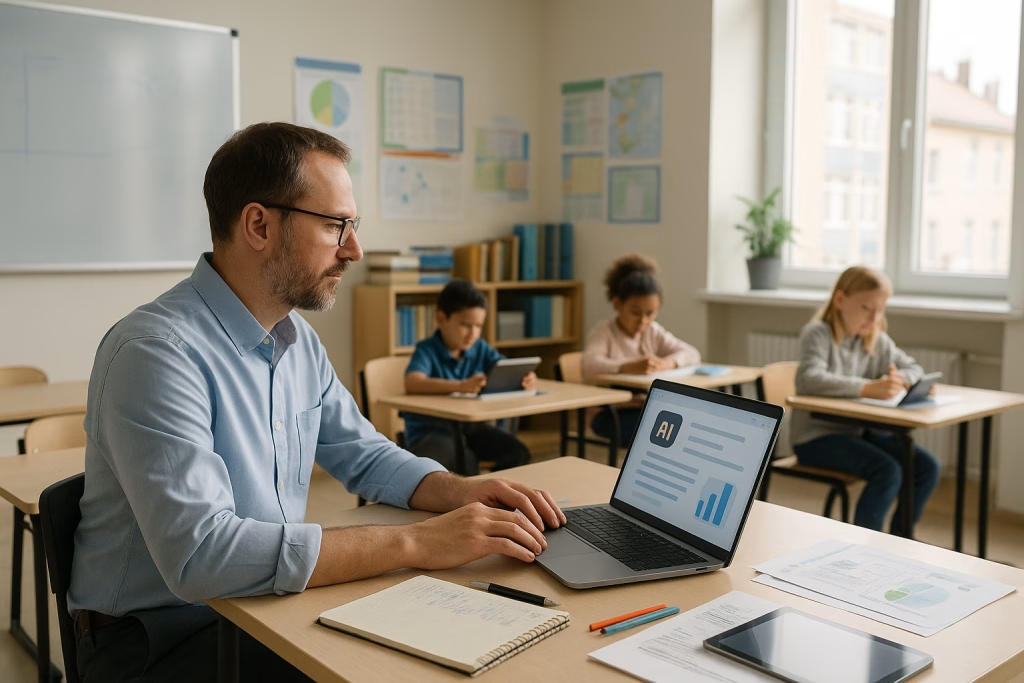
ChatGPT for Teachers Free Access Empowers US K–12 Educators
If you’ve spent any time in the education space lately, you’ve likely noticed an unmistakable shift: artificial intelligence is quietly—and sometimes not so quietly—changing how we teach, plan, and connect in our schools. When I came across OpenAI’s announcement of ChatGPT for Teachers, I couldn’t help but imagine its impact reverberating through bustling staff rooms and thoughtful lesson-prep sessions alike. For US K–12 educators, free access to this secure workspace until June 2027 opens real doors, not just in theory, but in the daily fabric of educational life. Let me take you through what this means practically and why, if you’re a teacher, this really does matter for your day-to-day.
What is ChatGPT for Teachers?
ChatGPT for Teachers is, at its heart, a version of OpenAI’s renowned conversational AI, thoughtfully tailored to meet the nuanced needs of teachers and school administrators. It’s not just another web app floating around waiting for a purpose. Instead, it’s a secure, compliant, and highly adaptable digital workspace—built on the back of the advanced GPT-5.1 Auto model—equipped specifically for education professionals.
Access is free for verified US K–12 educators through June 2027, following identification by SheerID. That’s over 150,000 teachers already benefiting within select districts—a number set to grow, no doubt, as word spreads and more educators verify.
What grabbed my attention immediately? The environment is private and secure—with robust admin controls—meaning leadership can manage access and data with absolute peace of mind.
Key Features at a Glance
- Unlimited message generation—no arbitrary caps to stifle your workflow.
- File uploading—integrate teaching materials and resources seamlessly.
- Native integrations with tools like Canva, Google Drive, and Microsoft 365—so you can stay focused in one digital workspace.
- Image generation—develop visual teaching aids on demand.
- Collaborative workspace—share lesson plans and resources with colleagues.
- Deep personalisation—customise the tool to reflect your curriculum, teaching style, and specific classes.
Why Secure, Dedicated AI Spaces Make Sense for Schools
Having worked both alongside and within educational institutions, I’ve learned how security and compliance aren’t just boxes to tick—they are the foundation of trust, especially when young learners’ data is involved.
ChatGPT for Teachers delivers peace of mind by ensuring:
- All access is gated behind educator verification.
- Comprehensive admin controls for school and district leaders—controlling user permissions, data retention, and privacy settings.
- Automated compliance with educational data protection mandates.
This approach shields both students and staff, providing a sandboxed environment where innovation can flourish minus the nagging data privacy concerns that have sometimes shadowed the adoption of digital learning tools in schools.
The Practical Reality: How ChatGPT for Teachers Actually Delivers
Now, you might be thinking, “Does AI really help with the nitty-gritty tasks we face as teachers?” Speaking from experience—yes, when done right, it can be utterly transformative.
Let’s look at how this workspace reimagines routine and creative work for educators:
Lesson Planning Without the Headache
With unlimited message capabilities, I’m able to whip up detailed lesson plans, entirely aligned with the curriculum, weeks ahead of schedule. A busy Monday night no longer means I’m alone at my desk surrounded by battered textbooks and post-it notes.
- Type a prompt: “Create a four-week English poetry block for Grade 9, including formative assessments and homework tasks.”
- Get back a complete breakdown, which I can tweak and tailor.
- Quickly export plans into my favourite templates or straight to Google Drive for sharing.
It’s a far cry from the old days of juggling a half-dozen windows and word docs, praying the photocopier doesn’t die on me before that first bell.
Assessment and Feedback, Streamlined
Automation doesn’t mean losing the human touch; it means you get more room to be human where it matters. From generating end-of-topic quizzes to delivering differentiated feedback, I can spend less time on rote admin and more on focused intervention—for those learners who really need it.
- Generate various question types, from multiple-choice to open-ended, in seconds.
- Use AI-generated rubrics for consistent, impartial marking.
- Track class performance trends across the term using built-in analytics.
I’ve watched colleagues breathe a sigh of relief when technology just works, letting us focus on those before-and-after class chats that end up shaping student outcomes.
Supporting Classroom Management and Routine Communication
There’s always that one class—energetic, unpredictable. Whether you’re a new teacher or a seasoned hand, fresh strategies for classroom management never go amiss.
- Access a bank of conflict-resolution suggestions tailored to your classroom’s age group and temperament.
- Quickly create communication templates—newsletters, notices, parent updates—no need to start from scratch each time.
- Collaborate live with colleagues; share and adapt each other’s resources within your workspace.
This is the sort of groundwork that, in my book, makes a real difference over the long year. Calm heads, well-supported by technology, often become the most effective.
Beyond Routine: Creativity and Adaptability
Let me paint a picture—it’s 7:30 am, a lesson idea sparks just as I’m sipping my morning cuppa. Rather than risk forgetting it, I quickly outline the idea in ChatGPT, ask for image suggestions, and have suitable visuals ready before the class shuffles in.
The power and flexibility to integrate imaginative prompts, creative exercises, and variant lesson flows have made me rethink those days when inspiration was in short supply. AI serves as my brainstorming buddy, never judging, but with a knack for delivering angles I’d never have pursued unaided.
Collaboration: Building a Community of Practice
Teaching can feel solitary—even for those of us who love it. What I’ve found remarkable about ChatGPT for Teachers is its focus on enabling collaboration.
- Resource libraries curated by and for teachers, accessible and always growing.
- Live project workspaces for co-developing interdisciplinary units.
- Effortless sharing, adaptation, and feedback on lesson plans, quizzes, and prompts—cutting down on silos and duplication of effort.
More than once, I’ve adopted a colleague’s prompt, made it my own, and saved hours in the process—it’s the kind of mutually supportive system every staffroom could do with.
Safety and Compliance—A Non-Negotiable Standard
For school and district leadership, treading carefully in the digital era is always front of mind. The stakes of a data breach or tool misuse are high—not least for those holding the keys to school-wide technology decisions.
ChatGPT for Teachers delivers:
- Strict verification through SheerID—so only bona fide educators get access.
- Admin dashboards that put real-time controls in the hands of IT leads or compliance officers.
- Regular security audits and transparent data policy guidelines—a relief for every overworked, risk-averse administrator (we see you!).
Speaking with IT directors and technology leads over the years, I’ve seen how often risk-aversion and bureaucracy can kill momentum. Knowing a solution arrives with built-in guardrails and compliance pathways often shortens those approval timelines dramatically.
Integrations: Bringing Your Favourite Tools Along
Let’s face it—teachers are only too familiar with juggling countless tabs, logins, and file types. ChatGPT for Teachers aims to remove friction by slotting neatly into existing toolkits.
- Sync up with Google Drive to fetch, store, and share teaching materials with zero fuss.
- Design eye-catching handouts in Canva and pull them straight into your classroom resources bank.
- Collaborate in real time using Microsoft 365 or whatever your district’s tech stack happens to be.
If, like me, you believe in working smarter—not harder—this all-in-one approach carries healthy appeal.
Data Analytics: Teaching That Reflects and Adapts
Another area where AI truly shines is helping make sense of all that data we collect but rarely have the hours to dig into.
- Aggregate student performance across assignments, pinpointing gaps.
- Set up alerts for trends—be it attendance drops, declining grades, or engagement spikes.
- Refine interventions based on timely analytics, not outdated hunches.
This data-driven protocol takes much of the guesswork out of differentiation and intervention, putting the sharp edge on teaching strategies, especially when running on a shoestring schedule.
Real-World Examples: Straight from the Staffroom
Here’s a flavour of how ChatGPT for Teachers has changed routines for me and colleagues I’ve chatted with:
- Streamlined lesson mapping—No more spinning wheels on sequencing units. The AI suggests logical arcs, then adapts materials to suit each class’s ability profile.
- Lightning quizzes and feedback loops—Pupils get instant formative assessment, and I’m not staying up until midnight marking.
- Parental comms, made easy—Pre-built templates spare me the blank-page panic ahead of parent-teacher conferences.
- Conflict management—Whenever a tricky incident flares up, I consult the platform’s archive of de-escalation strategies (I’ll admit it—sometimes the AI’s suggestions are refreshingly creative!).
- Peer resource sharing—A late-night SOS solved by dipping into the shared community bank. My stress levels thank me every time.
The Strategic Impact on Schools and Districts
From an administrator’s perspective, tools like this don’t just ease workloads. There’s wider strategic value:
- Consistent teaching standards—With quality-assured resources, schools see more consistent classroom delivery across year groups (a bugbear for many leadership teams).
- Support for new teachers—No one’s left fumbling in the dark. All staff access shared resources, policies, and starter packs from day one.
- Transparent data management—Audit every access, edit, and share for improved safeguarding and compliance.
- Cloud-based continuity—Absences no longer derail learning when every resource is accessible and versioned online.
It’s not an overstatement to say that these efficiencies are already feeding into improved Ofsted results and morale on the ground—though, as any seasoned teacher will agree, a happy, motivated staffroom is the real metric that counts.
OpenAI’s Support for Future-Ready Schools
Looking beyond daily tasks, OpenAI is investing in educator development at scale. I’ve had the chance to look at their AI Literacy Plan for Education Leaders—a practical roadmap for upskilling staff, demystifying AI, and embedding ethical data practices in every classroom.
There’s also a growing tapestry of partnerships worldwide, reaching beyond the US to places like Estonia and Greece, where ministries of education are exploring safe, effective AI rollouts.
For educators in Poland and elsewhere—rest assured, the momentum is coming, and in time, teachers everywhere will be empowered to leverage AI responsibly, with both effectiveness and safeguarding baked in.
Limitations and What Lies Ahead
It’s worth grounding our excitement in reality. For now, the free workspace is exclusive to verified US K–12 teachers. That leaves out the wider international cohort and independent educators for the time being. Still, the scale of uptake—over 150,000 verified users and counting—suggests broader rollouts may only be a matter of time (and negotiation).
The verified-only approach, while sometimes frustrating for those on the margins, does serve an important gatekeeping function, ensuring safety and public trust remain central to adoption.
There’s also no getting away from the fact that, impressive as any AI is, it’s not about to substitute the unique intuition, humour, and empathy of a real teacher. ChatGPT for Teachers supports, but never replaces, the craft that happens at the chalkface.
Reflections from the Chalkface
Let me come clean—as a teacher, I’d always eyed technology with a dose of scepticism. Too often, promises have arrived with hefty caveats, clunky rollouts, or a sense that we’re looking for silver bullets where none exist.
Yet, my experience with ChatGPT for Teachers has convinced me of its place as a real-world ally. It’s freed precious time, reduced my paperwork pile, and even nudged me to try new angles on old topics. I’ve had long Fridays saved by a well-timed AI-generated quiz, and discovered fresh classroom management tools that I couldn’t have imagined would work until I tried them.
Even more—they’ve sparked collaboration, not competition, amongst colleagues. We lift each other. We swap wins and lessons learnt. And, quite honestly, the emergence of a lively, supportive digital staffroom has put wind in our sails.
If you’d told me five years ago I’d be riffing back and forth with a helpful AI sidekick, sharing resources on impulse, and finding admin tasks beautifully less abrasive—I might have laughed. Now, it’s just part of my rhythm… and I wouldn’t trade the support.
Final Thoughts: The Shape of Things to Come
The shape of modern education continues to shift—sometimes subtly, sometimes with a mighty wallop. As OpenAI’s ChatGPT for Teachers unlocks new avenues for creativity and connection, it’s clear we’re entering an era in which digital tools complement, rather than dominate, the art of teaching.
If you’re one of the lucky US-based K–12 educators eligible for this free access, my advice is simple: dive in, experiment boldly, and share your journeys with those around you. For the rest of us watching from across the pond or from different educational settings—take heart. The train is picking up speed, and our time will surely come.
After all, for those of us who see teaching as as much a craft as a calling, the promise isn’t about being replaced—it’s about being better supported than ever before. And from where I sit, that’s worth toasting with a cuppa (or three)!
Relevant Resources
- OpenAI Announcement on X
- Make.com Automation Tools
- n8n Workflow Automations
- OpenAI Blog: ChatGPT for Teachers (if available)
If you’d like to chat, swap ideas, or share your own early forays into AI-assisted teaching, I’m all ears. It’s by putting our heads together, after all, that we shape the smarter classroom of tomorrow.