
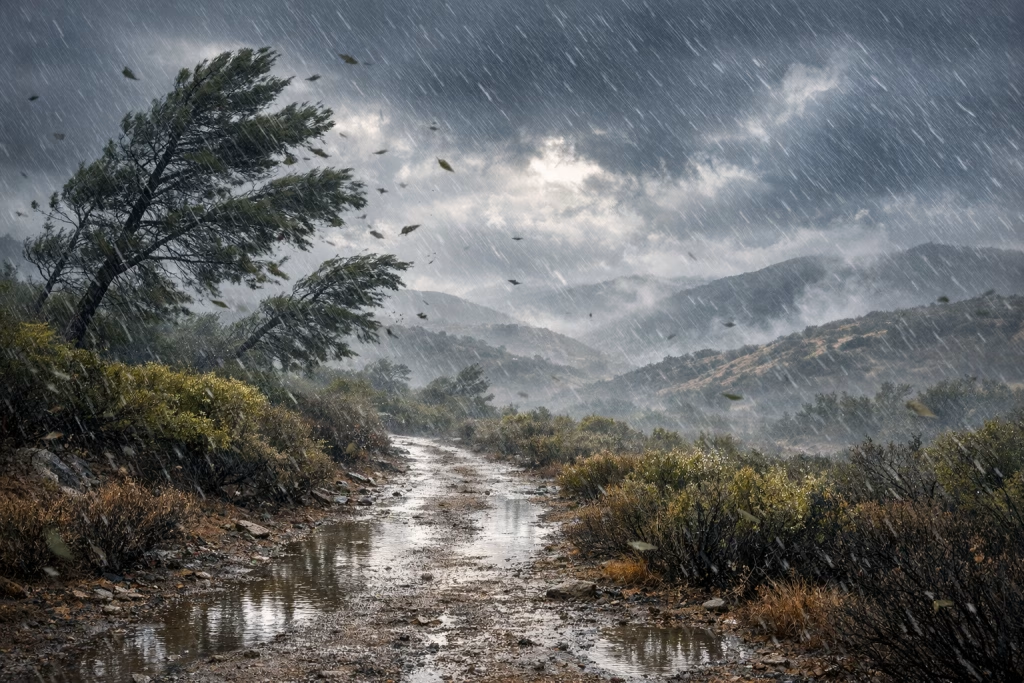
San Diego Rainfall 2025-2026 Detailed Weather Breakdown
I’ve always found rainfall in Southern California slightly theatrical: long stretches of blue-sky calm, then a burst of weather that feels almost overcommitted. If you live in San Diego (or you’re planning a trip), you’ve probably experienced that odd contrast yourself. In this post, I’ll walk you through a detailed, month-by-month look at San Diego rainfall in 2025–2026, based on a local rain gauge record from the Elfin Forest area (north inland San Diego County, between coastal communities and Escondido), plus comparisons to nearby National Weather Service reports mentioned in the source notes.
I’m writing this the way I’d explain it to a friend: clearly, with numbers where they matter, and with just enough context so the data means something. You’ll see that rainfall totals didn’t just vary month to month; they also shifted dramatically by micro-area—coast vs inland valleys vs foothills and mountains. If you’ve ever wondered why your street stayed dry while a friend ten miles away sent you photos of flooded driveways, you’ll feel right at home.
Quick context: what this breakdown covers
This article focuses on rainfall events from 2025 into early 2026, with the most detailed entries around late 2025 and winter 2026. The underlying notes refer to a local station in Elfin Forest at 777 feet elevation. I’ll treat those figures as the primary “home base” record and then pull in nearby National Weather Service (NWS) comparison points that appear in the same notes (for example, Ramona and Julian are cited as reference areas).
Because rainfall reporting can differ by station placement, instrumentation, and timing cut-offs, I’m keeping the discussion practical:
- We focus on observed totals from the gauge notes and the cited comparison locations.
- We highlight timing (multi-day storms often matter more than a single calendar day).
- We point out regional spread when inland and mountain totals differ sharply from coastal ones.
Why San Diego rainfall can feel “uneven” in real life
When I first started paying attention to San Diego rainfall patterns, I expected neat, city-wide storm totals. That’s not how it works. San Diego County covers coastline, mesas, inland valleys, and mountains. Storm bands can clip one corridor and spare another. Add terrain effects, and you get a familiar pattern:
- Coastal zones often receive modest totals from the same system that drops heavier rain inland.
- Foothills and mountain-adjacent communities can see much larger totals, sometimes multiple times higher.
- Wind events can accompany rain, complicating how the storm “feels” even when totals look moderate.
In the 2025–2026 notes, that unevenness shows up repeatedly. Some events deliver under half an inch in one spot while nearby inland stations report two inches or more during the same window. You don’t need to be a meteorologist to appreciate the impact—your garden, your commute, and even local creek levels will tell you the story.
Autumn 2025: the rainy season starts to show its hand
Autumn in San Diego often reads like a slow warm-up: a hint of showers, then a more organised set of systems once the season turns. In the notes, September and November 2025 offer a useful contrast—one shows scattered local activity, the other shows more structured waves.
September 2025: localised storms rather than a broad pattern
Early September rainfall in San Diego County can be very patchy. In the source notes, 3 September shows small amounts recorded at inland reference points, listed as examples by NWS: Ramona around 0.30 inches and Julian around 0.03 inches. That’s the sort of spread that reminds you how narrow some storm cells can be.
If you’ve lived here a while, you’ll recognise the vibe: one neighbourhood gets that wet pavement smell and a quick rinse; another stays dusty, as if the clouds changed their mind mid-flight.
November 2025: three waves that set the tone
By November, rainfall events tend to look more like what most people picture when they think “storm system.” The notes describe three storms in November, each contributing measurable totals.
- 15–16 November: The storm arrived with a delay, showing 0.18 inches by the evening of the 15th, then reaching 1.54 inches by the morning of the 16th after overnight rain.
- 18 November: A second wave added 0.73 inches (counted from the evening of the 17th into the morning).
- 20–23 November: A third system started with 0.12 inches on the 20th and brought totals to 0.46 inches by the 23rd, with the note that some coastal areas had been forecast closer to an inch.
What I take from those three entries is consistency: instead of a one-off shower, you get a sequence. That matters for soil saturation and run-off. You might not notice it on day one, but by day three your driveway puddles linger longer, and the ground stops “drinking” as fast.
What November 2025 suggests about storm behaviour
Even within these organised waves, the notes mention storms “missing” the Elfin Forest area by a bit. That’s classic San Diego County reality. A system can arrive broadly, but the heaviest rain bands still choose favourites.
For planning purposes—especially if you commute between coastal and inland areas—this is where I recommend paying attention to where the rain actually fell, not just what the general forecast predicted.
December 2025: holiday rain with some real bite
December can be deceptively variable in San Diego. Some years feel almost spring-like. Others deliver a couple of strong, memorable storms. The notes highlight two late-December events that stand out.
24 December: a “holiday gift” of heavier rain
The record describes 0.65 inches on 24 December, with heavy bursts. It also references much larger totals far to the north in the mountains of the Los Angeles region (the note mentions up to ten inches in that context). I won’t generalise that northern mountain figure to San Diego County, but it does help frame the broader regional pattern: California storms can stack rainfall dramatically where terrain forces lift.
If you drove during that window, you probably remember the combination of slick roads and that sudden rush of holiday traffic. Rain on dry pavement turns intersections into skating rinks for a day or two, and everyone drives as if they’ve just met water for the first time. I’ve been there, and I’ve learned to leave early and keep it calm.
27 December: another measurable event
Later in the month, 27 December shows 0.29 inches after overnight showers. Totals like that sound modest, but in a climate that often runs dry, even a quarter-inch can matter for short-term vegetation and local trail conditions—especially when it follows an earlier wet spell.
January 2026: a multi-day pattern and steady accumulation
January in the notes reads like a sequence of lighter episodes that add up. You may not get a single jaw-dropping daily total, but the repeated rain keeps the ground wet and the air cool.
2–5 January: light showers, then a stronger combined storm total
The entry describes a run from 2 to 5 January:
- 2 January: about 0.07 inches
- Night of 3 January: about 0.05 inches
- By 4 January: about 0.20 inches noted for the short period, with a reference to a 1.87-inch storm total (as described in the notes)
- By 5 January: an additional 0.49 inches, and a “two-day total” mentioned as 0.59 inches
The way the note is written suggests multiple measurement cut-offs across days, which happens often with personal gauges and diary-style weather logs. The practical message remains clear: rain arrived in pulses, and the accumulation over the event window mattered more than any single brief reading.
How these January patterns affect day-to-day life
From experience, this is when San Diego feels most “wintery” to locals. Trails stay muddy. Morning commutes run slower. You start to recognise which gutters overflow first on your street. Personally, I also notice how people’s patience thins just a touch—grey skies do that, even in California.
February 2026: stronger storms, wind, and major regional differences
February is the main act in this dataset. The notes describe three storms and include both rainfall totals and wind speeds. If you want to understand “San Diego rain season” in a single month, February 2026 gives you plenty to work with.
Mid-to-late February storm sequence (Elfin Forest totals)
The notes list the following for Elfin Forest:
- 16 February: 0.44 inches (first storm), with wind reported around 46 mph
- 18 February: another 0.44 inches (second storm), with the combined total referenced as 1.89 inches, and wind up to 54 mph
- 20 February: 0.59 inches (third storm), with the combined total referenced as 2.48 inches, and wind around 36 mph
I’m careful with wind numbers because wind measurement depends heavily on exposure and station setup, but as a lived experience it tracks: when you combine rain with gusty conditions, the storm feels more intense, trees drop debris, and the power-outage risk inches upward.
NWS comparison points mentioned in the notes (regional spread)
The notes also cite comparison figures that show how uneven the totals can be across the county and nearby mountain regions:
- On or around 18 February, examples include Julian around 0.79 inches and Ramona around 2.61 inches.
- By 20 February, examples include Poway around 2.08 inches, La Mesa around 1.98 inches, and Julian around 4.78 inches.
- The notes also reference significant mountain snow in the wider region (for example, the San Bernardino Mountains) during this period.
Those figures tell you something important if you drive across the county: your conditions depend on your route. A coastal errand might mean light rain and glossy roads. A trip inland could mean heavy rain, stronger gusts, and even winter travel impacts in higher elevations.
Why February 2026 stands out
Three things make this month notable:
- Repeated storm hits: the ground didn’t fully dry between events.
- Wind paired with rain: that combination increases hazards (downed branches, reduced visibility).
- Big inland/mountain totals: the range in the comparison points is not subtle.
If you asked me what to do differently during a month like this, I’d say: keep your phone charged, clear yard drains early, and don’t assume your neighbourhood’s rain tells you what’s happening ten miles away.
Spring rainfall notes: smaller events with a few surprises
The source notes also mention springtime events with lighter totals, plus one stronger March storm. Even though the phrasing in the notes references “spring 2025,” I’ll treat these entries as a separate cluster of spring-like events, because the practical insight holds either way: spring rains in San Diego often show up as brief, sometimes quirky systems.
Early February light rainfall (small totals)
- 6 February: about 0.02 inches
- 12 February: about 0.13 inches with light rain
These are the “barely there” rains that still change the day. The air smells cleaner. The dust settles. If you’ve got pollen allergies, you might even feel a little relief.
March: a stronger storm and then a more typical follow-up
- 7 March: a storm producing about 1.53 inches, described in the notes as unusual in shape/behaviour
- 11–12 March: about 0.44–0.46 inches, described as within an expected forecast range
I like these March entries because they show two common realities: one storm behaves oddly and drops a meaningful total, then another comes through in a more predictable way. If you manage property, schedules, or outdoor work, those “odd” systems are the ones that catch you out.
April: light showers to round things off
- 26 April: about 0.08 inches after overnight showers
By late April, San Diego often shifts back toward dry comfort. A small shower at that time feels almost polite—a brief interruption rather than a seasonal statement.
What these totals mean in practice (garden, travel, and planning)
Numbers matter, but outcomes matter more. Here’s how I’d translate the 2025–2026 pattern into plain decisions you can use.
If you garden or manage landscaping
- Clustered storms (like November and February) raise the chance of run-off and pooling. You’ll want to check soil drainage before the sequence starts.
- Light “top-up” rains (like 0.08–0.13 inches) won’t replace irrigation for long, but they can reduce stress briefly and help with dust suppression.
- Windy rain events increase branch drop and can damage young plants. I usually stake anything tall and vulnerable before a gusty system.
If you drive across microclimates (coast to inland, or toward higher ground)
- Assume variability: inland totals can be much higher than coastal totals during the same storm window.
- Plan for debris after windy storms (especially in February-style events).
- Watch mountain travel separately: the notes mention major snow in regional mountains during the winter pattern, and that can affect routes even if your house stays rain-only.
If you plan outdoor activities
- Multi-day systems matter for trails. Even “moderate” rain totals can keep clay-heavy trails muddy for days.
- Short showers can still make rocks slippery. I’ve learned that the first rain after a dry stretch is the one that makes everything slick.
Regional comparisons: why Elfin Forest can differ from Ramona, Poway, La Mesa, and Julian
The notes repeatedly compare Elfin Forest with other local stations. I won’t claim a single mechanism explains every gap, but in San Diego County a few patterns show up often:
- Elevation and terrain influence lift and rainfall efficiency.
- Storm track can shift rain bands north/south or coast/inland by a small distance with a big effect on totals.
- Convective bursts can dump heavy rain in a narrow corridor while leaving adjacent areas with drizzle.
When the notes mention that some storms “passed by” Elfin Forest, that aligns with the lived experience of storm bands. You can stand in your garden under a light shower while watching a darker, heavier curtain of rain over the next ridge.
A practical month-by-month recap (for quick scanning)
If you want the fastest possible view, here’s a compressed recap drawn from the notes.
2025 highlights
- September: localised showers; example reference points show small totals (e.g., around 0.30 inches at one inland location and near-trace at another).
- November: three storms; the strongest noted window (15–16 Nov) reached about 1.54 inches by morning after overnight rainfall.
- December: notable rain on 24 Dec (0.65 inches) and 27 Dec (0.29 inches).
2026 highlights
- Early January (2–5 Jan): repeated light rain with broader event totals noted across the window.
- February (16, 18, 20 Feb): three storms with wind; Elfin Forest entries include 0.44, 0.44, and 0.59 inches, plus large comparison totals elsewhere.
- March: one stronger storm around 1.53 inches, then a more typical system around 0.44–0.46 inches.
- Late April: light shower around 0.08 inches.
How I’d use this data if you asked me for a simple rain-season plan
I’ll keep this grounded. If you live in San Diego County and you want a reasonable plan based on patterns like these, I’d do the following:
- Before November: clear drains, check downspouts, and make sure you’ve got decent tyres. Early-season rain often hits after long dry stretches, and the roads get slick fast.
- During clustered storm months: avoid complacency on day two and day three. That’s when saturated ground, run-off, and debris become more likely.
- When wind joins the party: park away from large branches if you can, and keep outdoor items secured. A 50+ mph gust can turn a small patio item into a nuisance rather quickly.
- If you travel inland or uphill: treat that as a separate forecast zone. I do that even for short trips because conditions can change quickly with elevation.
SEO notes: what to search if you want to cross-check rainfall patterns
If you like verifying details (I do), these search terms typically help you find comparable public summaries and station outputs:
- San Diego rainfall 2025
- San Diego rainfall 2026
- Elfin Forest rainfall
- Ramona rainfall February 2026
- Julian rainfall February 2026
- Poway rainfall totals
- La Mesa rainfall totals
Station data can vary depending on the network (official stations, cooperative observers, personal weather stations). When you compare, pay attention to the timestamp window and whether the total reflects a calendar day, a storm total, or a rolling 24-hour period.
A brief aside: why “precision and control” matters when you turn weather data into content
I’m going to share something from my day job because it’s genuinely relevant if you publish weather recaps, local reports, or any data-heavy posts. OpenAI recently posted about greater precision and control in image generation—systems that can follow instructions, preserve requested details, and render fine-grained elements more reliably. I’ve seen the same need in content workflows: when you turn raw notes into a readable article, you want the output to keep the details intact while still sounding human.
If you build automations in tools such as Make or n8n, you can set up a tidy pipeline that helps with:
- Data capture (structured fields for date, location, amount, notes)
- Consistency checks (flagging mismatched totals or unclear cut-offs)
- Draft generation (turning bullet logs into narrative sections without losing numbers)
- Publishing format (HTML-ready output with headings, lists, and emphasis)
I mention this because it’s easy to lose trust with readers when one figure drifts or a time window becomes vague. Whether you use AI or write everything by hand, you and I both know the same rule applies: get the specifics right, then make it readable.
Final takeaways (without the fluff)
These 2025–2026 notes paint a familiar San Diego picture: rain arrives in bursts, totals vary sharply by area, and wind can make a moderate rainfall event feel far more serious. If you take one practical idea from this post, let it be this: treat San Diego County as a set of microclimates, especially in winter.
If you want, tell me where you live (coastal, inland valley, foothills) and what you’re trying to do with the data (travel planning, garden decisions, content publishing). I’ll adapt the same breakdown into a tighter checklist for your situation, still in clean HTML, and still with the numbers front and centre.