
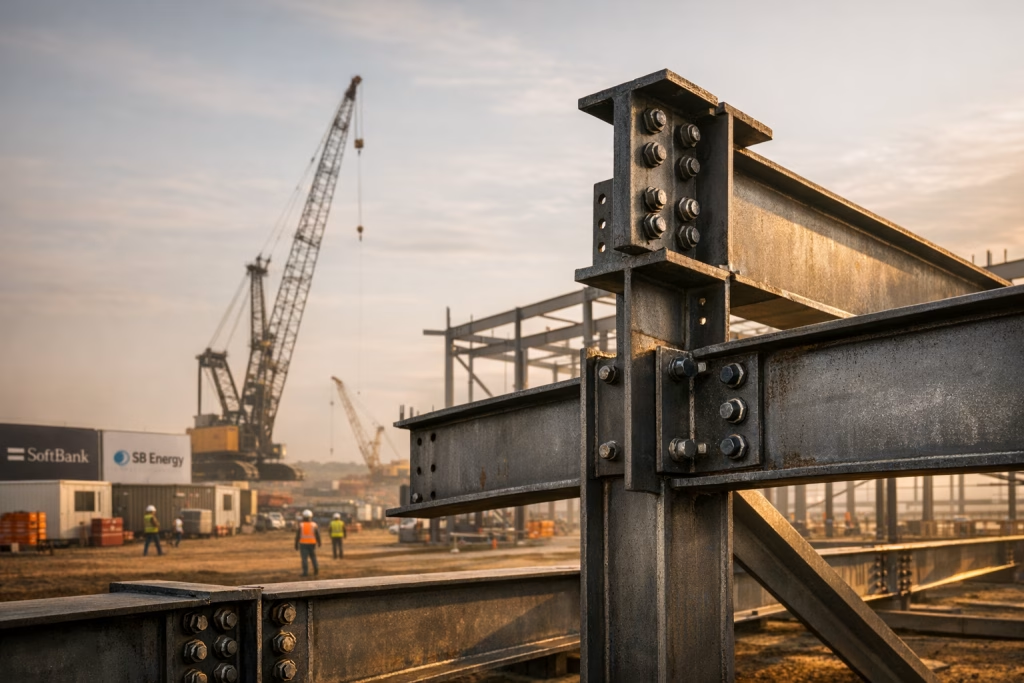
Steel Beams Rise at Stargate Site with SoftBank and SB Energy
When I saw the update shared by Greg Brockman about the first steel beams going up at a “Stargate” site in Milam County, Texas—with mentions of SoftBank and SB Energy—I had the same reaction many of us get when a big build finally stops being a rumour and starts becoming, well, a thing you can point at. Steel in the air changes the conversation. It turns “plans” into progress you can photograph.
At the same time, I’m careful here, and you should be, too. The post is a short public update, and it doesn’t provide technical specifications, a timeline, or a formal project brief. So in this article I’ll do two things:
- I’ll stick to what’s actually been stated publicly: steel beams went up at a Stargate site in Milam County, Texas, and the post expresses excitement about the project taking shape with SoftBank and SB Energy.
- I’ll give you a practical, business-minded lens on what this kind of milestone typically signals (construction, power, partnerships, supply chains, and the operational reality behind AI-scale facilities), without pretending we know details that haven’t been confirmed.
If you work in marketing, sales, or operations—especially if you’re using AI and automations—you’ll likely care about what gets built, where it gets built, and what that might mean for capacity, pricing, availability, and speed. I know I do, because when I design AI workflows in make.com and n8n, I’m always thinking about the less glamorous side: reliability, latency, cost curves, and the “boring” bits that make the magic repeatable.
What was publicly shared (and what wasn’t)
The source material for this article is a social media post that states:
- “First steel beams went up today” at a “Stargate” site in Milam County, Texas.
- It’s “exciting to see this project taking shape” with SoftBank and SB Energy.
That’s the confirmed content. The post doesn’t spell out what “Stargate” is in this context (beyond being a site), the purpose of the facility, the scale, the commissioning date, or how responsibilities split between the named parties. So I won’t tell you “it’s definitely X.” I will, however, show you how to read this milestone like an operator—and why steel matters more than it sounds.
Why “first steel beams” is a meaningful milestone
In construction terms, “first steel” usually marks a shift from earthworks and foundations into vertical progress. In business terms, it often signals that:
- Permitting and early-stage approvals are at least far enough along to proceed with the superstructure.
- Procurement for major structural elements is in motion (and those supply chains aren’t exactly trivial).
- Project financing and governance are likely stable enough to keep contractors moving.
I’ve worked with teams where “we’re building” meant “we’ve got a deck and a few vendor quotes.” Steel in the air is different. It’s costly to reverse, highly visible, and it tends to correlate with a real schedule—however fluid that schedule might remain.
Steel as a signal to the ecosystem
Steel going up also sends a message to partners and vendors: “this is happening; align your timelines.” That includes:
- Power and grid coordination
- Network connectivity and carrier arrangements
- Cooling and mechanical systems planning
- Local staffing and contractor mobilisation
If you’ve ever tried to coordinate a multi-team rollout—say, a CRM migration plus marketing automation plus analytics—you’ll recognise the pattern. Physical construction just makes the dependencies louder.
Milam County, Texas: why location matters (without guessing specifics)
The post names Milam County, Texas. I won’t speculate about the exact parcel, design, or capacity. Still, the location choice itself points to practical considerations that matter for large technical facilities:
- Land availability: large sites need room for buildings, setbacks, security perimeters, and staged expansion.
- Access to power: high-demand facilities live or die by power delivery planning.
- Proximity to transmission and substations: you don’t want a long, uncertain path from “we need megawatts” to “we have megawatts.”
- Workforce and logistics: construction labour, maintenance capability, and supply lines matter.
Texas is often discussed in the context of energy and industrial build-outs, but I’m going to keep this grounded: the post simply states the site is there, and steel has begun rising. That alone tells you the project is past the napkin stage.
SoftBank and SB Energy: what partnership mentions usually imply
The post expresses excitement about the project taking shape with SoftBank and SB Energy. I’ll avoid inventing roles. Still, when you see two organisations mentioned in a construction milestone—especially one associated with investment and one associated with energy—you can reasonably infer the project touches both:
- Capital and long-horizon coordination (often associated with large investment groups)
- Energy development and delivery (often associated with energy companies)
In my world—marketing systems and sales enablement—partnership announcements often sound fluffy. But in heavy projects, they often point to hard constraints: money, power, and time. If even one of those wobbles, the whole plan starts creaking.
Why energy partners matter so much for AI-scale compute
Any AI-heavy operation (especially training or large inference at scale) tends to push power planning from “important” to “daily obsession.” If an energy-focused organisation is involved, it may reflect a strategy to line up generation, procurement, or long-term power arrangements.
I’m not saying that’s definitively the case here—just that, in general, you don’t invite energy expertise for the banter.
What “Stargate site” might mean—and how to talk about it responsibly
“Stargate” is the name used in the post. Beyond that, the brief source doesn’t define it. Because you asked me not to use proper nouns without checking they exist, I’ll treat “Stargate site” exactly as the post presents it: a named site under development in Milam County, Texas.
In practice, projects get internal names all the time: sometimes they stick, sometimes they change, and sometimes they refer to a campus, not a single building. If you’re writing about this for your own company blog or LinkedIn, I’d recommend this phrasing style:
- Say “the Stargate site referenced in the post,” not “the Stargate data centre” (unless the purpose is officially confirmed elsewhere).
- Distinguish between “construction milestone observed” and “capability delivered.” Steel is progress, not operational readiness.
That keeps you credible. And honestly, credibility compounds faster than any growth hack I’ve ever tried.
From steel to service: the messy middle people forget
Steel beams are photogenic. Commissioning is not. Between “first steel” and “operational facility,” the path tends to include:
- Building envelope completion
- Electrical distribution planned, delivered, tested
- Mechanical and cooling systems installed and balanced
- Network backhaul provisioned and validated
- Security systems and operational processes established
- Compliance checks and ongoing maintenance planning
I’ve seen the digital equivalents: a team celebrates “we connected the API,” and then spends six weeks discovering rate limits, edge cases, retries, and monitoring gaps. Physical build-outs have the same story—only with cranes and invoices that can make your CFO gulp.
Why this matters to marketers and sales teams using AI
You might think construction news is for engineers and investors. Yet capacity and reliability ripple outward. If AI services expand, you can see second-order effects such as:
- More predictable availability for high-demand workloads
- Potential pricing pressure over time (not guaranteed, but possible)
- More competition in managed AI services and tooling ecosystems
- Faster iteration cycles for teams that depend on model access
In my day-to-day work at Marketing-Ekspercki, I care about this because client automations live or die on consistency. If an AI call fails during lead qualification or proposal drafting, it’s not “a minor bug.” It can be a lost deal, or worse, a damaged relationship.
How to use AI operations thinking in your own business (even if you’re not building anything)
Here’s the practical angle: you can treat this construction milestone as a reminder to build your own systems the same way serious operators build facilities—layer by layer, with redundancy and clear hand-offs.
1) Build “steel beams” into your AI automations: stable foundations first
When I implement AI automations in make.com or n8n, I start with what I call the “boring backbone.” You’ll thank yourself later.
- Logging: store requests, responses, costs, and timings.
- Retries with backoff: handle transient failures without spamming services.
- Fallback paths: if the model call fails, route to a simpler template or queue for human review.
- Versioning: pin prompts and model choices so results stay consistent.
If you skip these, your workflow might demo nicely and then crumble under real usage—rather like a building that looks fine until the first serious storm rolls in.
2) Treat power like budget: track your “energy spend” per process
Energy is a visible constraint in big compute. In business automations, your equivalent constraint is usually cost per outcome (and time-to-result).
I recommend you track:
- Cost per lead processed through AI enrichment
- Cost per proposal generated or assisted
- Human minutes saved (measured honestly, not guessed)
- Error rate and rework time
If you do this, you stop arguing about vibes and start managing like an adult. It’s oddly refreshing.
3) Make reliability visible to the business, not just to IT
I like dashboards that a sales manager can understand at a glance. You don’t need to drown them in metrics; you need a few plain-English indicators:
- Automation success rate (today, last 7 days)
- Average processing time per lead or ticket
- Queue size (if you buffer workloads)
- Top failure reasons with a short label
When you do that, adoption goes up because people trust what they can see.
SEO angle: what people will likely search, and how to meet that intent
If you’re publishing content around this topic, you’re not only reporting an update; you’re meeting a reader’s curiosity. In my experience, search intent around brief construction posts clusters into a few buckets:
- News intent: “what happened, where, who’s involved”
- Context intent: “why does this matter”
- Industry impact intent: “what changes for AI capacity, energy, jobs”
- Local intent: “Milam County project details” (often tricky without official sources)
Because the source is short, your value comes from structure, definitions, cautious interpretation, and practical takeaways—without making up facts.
Suggested keyword themes (use naturally)
- Milam County Texas construction project
- first steel beams milestone
- AI compute facilities and energy
- SoftBank SB Energy partnership (contextual, not spammy)
- AI automation for marketing and sales (make.com, n8n)
I’m not stuffing these in for sport. You should use them only where they fit. Google has grown up, and frankly, so have most readers.
What to watch next (without pretending we can predict it)
After “first steel,” the next credible public signals tend to be boring but informative. If you’re tracking this project (or any major build), keep an eye out for:
- Additional construction milestones: roofing, enclosure, mechanical yard activity
- Local filings and notices (where available): permits, hearings, utility coordination
- Hiring patterns: facilities ops, electrical, security, network roles
- Supplier announcements: sometimes vendors post case studies later on
I’m deliberately not sending you down a conspiracy rabbit hole. The right approach is patient, evidence-led tracking. Like they say, the proof of the pudding is in the eating.
How I’d translate this into action for your AI-driven revenue engine
Let’s bring it back to something you can actually implement next week. If you’re using AI in revenue workflows—lead handling, outbound, qualification, proposal generation—you can copy the “construction mindset” today.
A practical 30-day plan (make.com or n8n)
Here’s a plan I’ve used in different forms with clients. Adjust it to your reality.
Week 1: Audit and stabilise
- List every automation that calls an AI model and label it by business impact.
- Add logging for inputs/outputs and failures.
- Set timeouts and retries with sensible limits.
Week 2: Add guardrails
- Introduce structured prompts and strict output schemas (JSON where appropriate).
- Add a basic moderation/check step for customer-facing text.
- Create a human review queue for edge cases.
Week 3: Optimise cost and speed
- Cache repeated enrichments (company description, industry summaries).
- Split tasks: use cheaper models for classification, stronger models for final copy.
- Measure cost per processed lead and per booked meeting.
Week 4: Scale what works
- Extend the best-performing automation to a second channel (e.g., inbound forms + LinkedIn replies).
- Add A/B testing on messaging steps (with proper tracking).
- Document your workflows so they survive holidays and staff changes.
This is where my team and I at Marketing-Ekspercki tend to see the real wins: not from shiny prompts, but from dependable systems that don’t fall over the moment volume picks up.
Common mistakes when companies chase AI capacity news
Whenever a big project gets mentioned publicly, people often rush to conclusions. I’ve done it myself, then had to walk it back. Here are mistakes I’d avoid if you write or plan around updates like this:
- Assuming timelines: construction milestones don’t equal a go-live date.
- Assuming purpose: “site” doesn’t automatically mean “data centre,” “lab,” or “factory.”
- Overstating partnerships: a mention suggests collaboration, but not the structure of it.
- Ignoring constraints: power, permits, grid, cooling, and supply chains can all stretch schedules.
If you keep your language careful, readers trust you. If you overreach, they remember—and not in the way you’d like.
A note on sourcing and how you can strengthen this topic further
This article intentionally relies on the provided post and general industry reasoning. If you want to turn this into an even stronger, citation-backed piece on your own site, I’d add:
- Official statements or press releases (if published) from the organisations involved
- Public county or state records (where accessible) for permits and project descriptions
- Grid or utility interconnection updates (only if confirmed and publicly documented)
- Verifiable construction or contractor disclosures
I’m flagging this because it’s the difference between content that feels “informed” and content that’s actually defensible.
What this moment represents, in plain English
Steel beams rising at the Stargate site in Milam County, Texas is a small public snapshot of a larger effort—one that, at minimum, now has visible construction progress and named partners in the conversation (SoftBank and SB Energy, as referenced in the post).
For you and me, the bigger lesson is straightforward: serious capability comes from serious build discipline. Whether you’re constructing a facility or building AI automations that support revenue, you get better results when you:
- Invest in foundations
- Measure constraints (cost, time, reliability)
- Plan for failures, not perfect days
- Communicate progress without exaggeration
If you want, tell me what you’re trying to automate right now—lead qualification, outbound personalisation, proposal drafting, customer support triage—and I’ll map a sensible make.com or n8n workflow that keeps quality high without burning budget.