
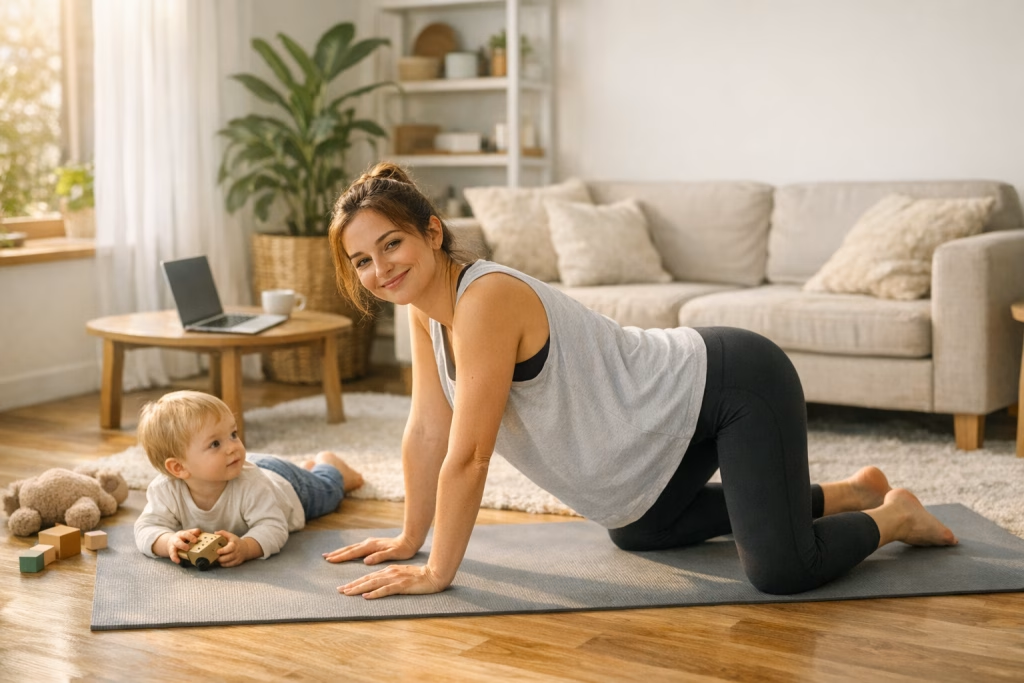
Flexible Workouts for Moms Using ChatGPT to Save Time
When I first heard the story about Lauren—a mum of two toddlers who uses ChatGPT to carve out a little time for herself with workouts that actually fit her unpredictable days—it landed with a thud of recognition. If you’re raising small children, you already know the rhythm: nothing runs on schedule, everything runs on snacks, and the moment you roll out a mat someone needs a nappy change, a cuddle, or a very specific cup in a very specific colour.
This is where AI can genuinely help. Not by “fixing” motherhood (good luck with that), but by reducing the mental load: planning tiny workout windows, offering options when a session gets interrupted, and helping you choose something realistic when your energy sits somewhere between “fine” and “please no”.
In this article, I’ll show you practical ways to use ChatGPT to plan flexible workouts for busy mums—especially if you have toddlers—without needing a rigid timetable, a complicated app ecosystem, or a full hour of silence. I’ll also share prompts you can copy, safety notes to keep you out of trouble, and a simple approach you can follow week after week.
Why traditional fitness plans fail most mums of toddlers
Most workout plans assume three things:
- You can predict your day.
- You can protect a fixed time slot.
- You can finish what you start.
If you’ve got toddlers, those assumptions fall apart fast. Naps shift, nursery bugs appear out of thin air, and your “free time” often arrives in awkward fragments—9 minutes here, 17 minutes there, and maybe a longer window if the stars align.
That doesn’t mean you can’t train. It means you need a plan designed for interruptions and low bandwidth. I’ve found that the best approach focuses on:
- Short sessions (5–25 minutes) that still feel worthwhile
- Modular structure so you can pause and continue later
- Low setup (minimal kit, minimal fuss)
- Clear options for low-energy days
- Simple progression you can follow even when your brain feels foggy
ChatGPT can support exactly that: quick planning, quick adjustments, and fewer decisions when you’re already making roughly a thousand of them.
What ChatGPT can and can’t do for your workouts
Let’s keep this grounded. ChatGPT can help you plan, adapt, and stay consistent. It can’t assess your body, diagnose pain, or replace a qualified medical professional.
How ChatGPT helps (the realistic bit)
- Creates flexible routines based on your time, space, and equipment
- Gives “if-then” alternatives when sessions get interrupted
- Suggests low-impact modifications when you feel tired or sore
- Builds a weekly structure that doesn’t collapse when your week does
- Reduces decision fatigue by keeping your options simple
Where you still need human judgement
- Postpartum recovery, pelvic floor concerns, diastasis recti, or pain
- Medical conditions, injuries, dizziness, or unusual symptoms
- Form checks (a mirror or a coach helps far more)
If anything feels “sharp”, “wrong”, or worrying, pause and speak to a professional. A workout plan should make you feel better in your body over time, not anxious about it.
The core idea: “Flexible workouts” designed for the toddler years
When Lauren uses ChatGPT for flexible workouts, the magic isn’t some secret routine. It’s the structure. Flexible workouts work when you stop treating a plan like a fragile vase and start treating it like a toolbox.
I like to think in three layers:
- Layer 1: Micro-sessions (5–10 minutes) for busy or chaotic moments
- Layer 2: Standard short sessions (15–25 minutes) for “normal” days
- Layer 3: Optional extras (5–15 minutes) when you unexpectedly get time
If you only manage Layer 1 for a week, you still maintain the habit. If you catch a couple of Layer 2 sessions, you progress. Layer 3 is a bonus, not a requirement. That sense of “I’m still on track” matters more than people admit.
Step-by-step: how to use ChatGPT to build a workout plan that survives real life
Step 1: Give ChatGPT the constraints (time, energy, equipment)
ChatGPT performs best when you treat it like a helpful assistant who needs specifics. Tell it what you actually have—not what you wish you had.
Here’s a prompt you can copy:
Prompt:
“Act as a fitness planning assistant. I’m a mum of two toddlers with unpredictable days. I want a flexible weekly plan with workouts I can do in 5–25 minutes. My equipment: (none / resistance band / dumbbells / stroller, etc.). My space: (living room / small flat / garden). My current fitness: (beginner/intermediate). I prefer (low impact / strength / cardio / Pilates-style). Build a plan with a 5–10 minute option for each day and a 15–25 minute option for 3 days per week. Include warm-up and cool-down suggestions.”
If you’re postpartum, add this clearly and ask it to keep intensity conservative unless cleared by your clinician.
Step 2: Ask for “interruptions built in”
Toddler life means interruptions. I recommend asking for routines that come in blocks.
Prompt:
“Create workouts in modular blocks (e.g., 3 blocks of 5 minutes). If I get interrupted, I want to be able to stop after any block and still feel like I completed something. Provide an ‘if interrupted’ alternative for each workout.”
Step 3: Build a simple progression (without overthinking it)
Progression keeps you from repeating the same comfortable session forever. You don’t need a complicated periodised programme. For most busy mums, one of these is enough:
- Add 1–2 reps per set each week
- Add one extra round of a circuit
- Reduce rest slightly
- Increase resistance very gradually
Prompt:
“Add a 4-week progression plan. Keep it realistic for someone who might miss sessions. Use small increases only. Give me a ‘minimum effective dose’ option if I only manage 2 workouts in a week.”
Workout ideas that fit into toddler chaos (with ChatGPT prompts)
Below are formats that tend to work well for mums with toddlers because they require little setup and tolerate interruptions. I’m sharing them in plain language, and I’ll include prompts so you can get personalised versions.
1) The “Kitchen Timer” workout (10 minutes)
You set a timer for 10 minutes, choose 3–4 moves, and cycle through them at a steady pace. No fancy counting. When the timer ends, you stop.
- Bodyweight squats
- Incline push-ups on a countertop
- Glute bridges
- Dead bugs (slow, controlled core work)
Prompt:
“Create a 10-minute kitchen-timer strength routine using bodyweight only. Make it low impact, toddler-safe (no jumping), and give simple form cues. Include a 2-minute warm-up.”
2) The “Nap Window” workout (20 minutes)
If you get a nap window, you want something efficient: a short warm-up, one main circuit, a quick cool-down. I like full-body work here because it gives you more return on time.
Prompt:
“Create a 20-minute full-body workout for a nap window. Use minimal equipment (specify). Format: 3-minute warm-up, 14-minute main circuit, 3-minute cool-down. Provide beginner and intermediate options.”
3) The “Stroller walk + strength” hybrid (25 minutes)
This one works well because toddlers often tolerate movement better than “mum staring at a wall doing lunges”, which—fair—can look odd.
- 10–15 minutes brisk walk with stroller
- 5 minutes bench/rail incline push-ups + bodyweight squats
- 5 minutes mobility (hips, calves, upper back)
Prompt:
“Build a 25-minute stroller-friendly routine: brisk walk intervals plus 2 short strength blocks I can do near a bench. Keep it low impact.”
4) The “Floor-only” session for zero motivation days (8–12 minutes)
Some days you’ll feel wrung out. Floor-only sessions remove friction: no shoes, no kit, no rearranging furniture. I’ve used these myself when I couldn’t face anything else.
- Cat-cow
- Bird-dog
- Side-lying leg raises
- Glute bridges
- Child’s pose breathing
Prompt:
“Create a gentle 10-minute floor-only routine for a tired mum. Focus on core stability, hips, and back relief. Avoid intense ab work; keep cues slow and clear.”
How to personalise workouts safely (especially postpartum)
If you’re postpartum, your body may still be shifting in ways that aren’t obvious day to day. I won’t pretend a text prompt replaces individual guidance, but you can use ChatGPT to stay conservative and structured.
Information to tell ChatGPT
- How many weeks/months postpartum you are
- Any medical guidance you’ve received
- Whether you experience leaking, heaviness, or pain with exertion
- Your preference for low-impact movement
Prompt:
“I’m (X) weeks/months postpartum. I want low-impact workouts and I’m prioritising core and pelvic floor-friendly movements. Please avoid jumping, intense crunches, and high-pressure core drills. Give me options if I feel heaviness or discomfort.”
And one practical note from my own experience of working with busy clients: you’ll do better with a plan that feels slightly too easy at first than one that feels heroic on paper. You can always increase later. You can’t easily recover time lost to injury or burnout.
A simple weekly structure that works even when your week falls apart
You don’t need seven perfect days. You need a plan that doesn’t punish you for having a normal family life. Here’s a flexible template that many mums find doable:
- 2–3 strength sessions (15–25 minutes)
- 2–4 micro-sessions (5–10 minutes) focused on mobility or light strength
- Walking when it fits (school run counts)
I like to set this rule: two “anchor” sessions per week plus tiny add-ons when life allows. Anchors keep your progress alive. The add-ons keep your mood and body comfortable.
Prompt:
“Build me a weekly workout template with two anchor sessions (20 minutes) and optional micro-sessions (5–10 minutes). Include a plan for what to do if I miss an anchor session, so I can still feel on track.”
Decision fatigue is the real enemy (and ChatGPT can reduce it)
If you feel stuck, it’s often not laziness. It’s the weight of choosing: what workout, what intensity, what order, what time, what to do if interrupted. Decision fatigue makes even small tasks feel like wading through treacle.
Use ChatGPT to pre-decide. I recommend creating three go-to workouts and naming them, so you don’t negotiate with yourself every day.
Create your “A/B/C” workouts
- A (good energy): 20–25 minute strength circuit
- B (medium): 12–15 minute lighter full-body
- C (low): 6–10 minute floor-only mobility + core stability
Prompt:
“Create three workouts: A (25 min), B (15 min), C (8 min). All low impact and toddler-friendly. Give me exact exercises, timing, and short cues. I want to reuse these for the next month.”
Once you have them, you just pick A, B, or C based on how you feel. No drama.
Practical ways to fit workouts into a toddler schedule (things I’ve seen work)
I’ll keep this realistic. You won’t always “find time”. Sometimes you’ll make it, sometimes you’ll borrow it, and sometimes it simply won’t happen. Still, a few tactics tend to help:
1) Use “bookends”
- 6–10 minutes right after you wake up
- 8–15 minutes after bedtime, before you melt into the sofa
2) Train in plain clothes occasionally
Fancy kit helps motivation, sure, but toddlers don’t care about your matching set. If changing clothes becomes the barrier, skip it. I’ve done plenty in leggings and a slightly questionable T-shirt.
3) Keep equipment visible
A resistance band on a door handle (out of toddler reach) or a mat folded in a corner reduces setup time. If you hide everything, you add friction.
4) Make workouts interruption-proof
Choose movements where you can stop safely mid-set. Slow strength and mobility work tends to win here.
Example: a flexible 7-day plan you can generate with ChatGPT
I won’t pretend one plan fits everyone, but this format gives you an idea of what “flexible” looks like in practice:
- Day 1: 20 min full-body strength (anchor) + 5 min stretch if time
- Day 2: 8 min floor-only mobility
- Day 3: 15 min light strength + easy walk (optional)
- Day 4: 20 min strength (anchor)
- Day 5: 6–10 min core stability + hips
- Day 6: Stroller walk intervals (20–30 min) if it fits
- Day 7: Rest or gentle mobility (5–10 min)
Prompt:
“Generate a flexible 7-day plan using two 20-minute anchor strength workouts, plus optional 5–10 minute sessions the other days. Make it low impact and suitable for someone with toddlers. Provide swaps if a day goes off the rails.”
How to use ChatGPT in a way that keeps you consistent
In my work at Marketing-Ekspercki, I see a familiar pattern: tools work when they reduce friction and create repeatable habits. The same applies here. If you want this to stick, use ChatGPT like a system, not a novelty.
Do a weekly “reset” conversation
- Tell it what went well last week
- Tell it what got in the way
- Ask for a revised plan with fewer assumptions
Prompt:
“Here’s what happened last week: (brief notes). Adjust my plan for this week to match reality. Keep two anchor sessions, but make the rest optional. Use the same A/B/C workouts and tell me when to use each.”
Ask for encouraging language that doesn’t feel cheesy
Some people like pep talks; some prefer calm, matter-of-fact reminders. Ask for the tone you’ll actually accept when you’re tired.
Prompt:
“Write short workout reminders in a calm, practical tone. No hype. Keep them to two sentences each.”
Safety and form: keep it simple, keep it sensible
Because ChatGPT can generate endless exercise lists, you’ll want a few guardrails:
- Prioritise controlled movements over fast, bouncy ones if you’re tired
- Stop 1–2 reps before failure most of the time
- Avoid pain (distinct from normal muscle effort)
- Use a shorter range of motion if a movement feels unstable
- Warm up briefly, even if it’s just marching on the spot
If you’d like, you can ask ChatGPT to include “red flags” that tell you to stop.
Prompt:
“For each workout, list red flags that mean I should stop and rest (e.g., sharp pain, dizziness). Keep it short.”
SEO notes you probably care about (and how this fits search intent)
If you searched for phrases like flexible workouts for moms, ChatGPT workout plan, quick workouts for busy moms, or AI fitness planning, you likely wanted a plan you can apply tomorrow, not theory. I built this post around that intent: concrete prompts, workable session formats, and a weekly structure that tolerates chaos.
And yes, the “Lauren” story resonates because it captures what many mums feel but rarely articulate: the need for movement that supports you, rather than another rigid standard you can’t meet.
Copy-and-paste prompt pack (so you don’t have to think)
Here are a few prompts in one place. Save them somewhere you’ll actually find them again.
1) Generate your plan
Prompt:
“Create a flexible weekly workout plan for a mum of toddlers. Workouts must be 5–25 minutes, low impact, minimal equipment, and modular so I can stop after any block. Include two 20-minute anchor strength sessions, plus optional micro-sessions.”
2) Create A/B/C workouts
Prompt:
“Design three reusable workouts: A (25 min), B (15 min), C (8 min). Low impact, toddler-friendly, and clear instructions. Add easy modifications.”
3) Plan for interruptions
Prompt:
“For each workout, add an ‘if interrupted’ option so I can still count it as done.”
4) Low-energy day support
Prompt:
“I feel exhausted today. Give me a 6–10 minute floor-only routine focused on hips, back, and gentle core stability. Keep it calm.”
5) Week-by-week progression
Prompt:
“Give me a gentle 4-week progression for these workouts using small increases only. Include a fallback if I only manage two sessions in a week.”
Where Marketing-Ekspercki fits in (if you want this automated)
You can run all of the above manually inside ChatGPT, and that already helps. If you like systems, though, you can also automate parts of it: weekly planning, reminders, and tracking.
In our work at Marketing-Ekspercki, we build AI-based business automations in tools like make.com and n8n. The same thinking applies on a personal level: reduce repeated admin, keep the human bits for decisions that matter, and let automation handle the boring repetition.
- Weekly workout planning: a scheduled message that asks you three questions (time, energy, any aches) and then generates your plan
- Daily reminders: a short nudge that offers A/B/C based on your available time
- Simple logging: saving what you did to a note or spreadsheet so you see progress without effort
If you want, you can tell me what tools you use (Google Calendar, Notion, Apple Reminders, Slack, email) and I’ll outline a practical automation flow—without making it feel like you’re running a NASA launch just to do a few squats.
A final note on time, guilt, and “good enough”
I’ll end on something I’ve had to remind myself of more than once: consistency in the toddler years often looks unimpressive on paper. Ten minutes here. Twelve minutes there. A walk that counts as cardio because you carried a screaming child like a sack of potatoes.
It still counts.
If you use ChatGPT to lower the planning burden and keep your workouts adaptable, you’ll likely find what Lauren found: more movement, less stress about it, and a small patch of time that feels like yours again.