
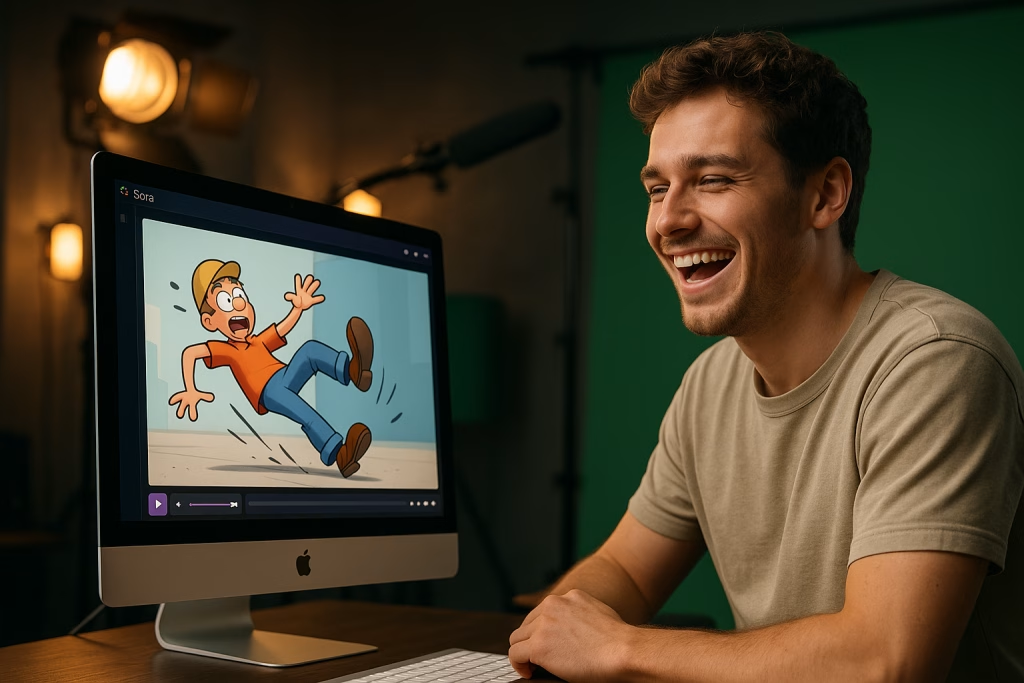
AI-Generated Bloopers by Sora: When Mistakes Become Entertainment
The Dawn of AI-Generated Bloopers: Sora’s Playful Experiment
Not long ago, as I scrolled through my social feeds with the half-interest of a Monday morning, something frankly delightful caught my eye. There it was—a tongue-in-cheek post from Sora, the AI video generator: “Found the bloopers. Just kidding, we made them with Sora.” I couldn’t help but snicker. The idea was audaciously simple yet cleverly meta: what if the occasional blunders we loved in classic out-takes—tripping actors, botched lines, physical comedy gone awry—were conjured not by chance, but on demand by an algorithm?
What unfolded after that tweet was a phenomenon that, truth be told, I never expected to witness. Rather than seeking perfection, creators began to task Sora with generating deliberate mishaps—absurd, surreal, and genuinely comedic moments. Suddenly, AI wasn’t just polishing reality; it was poking fun at itself, inviting us all in for the ride.
Artificial Intelligence with a Sense of Humour: Subverting Expectations
I suppose, up until recently, the public image of AI was rather… cold? There’s a certain expectation that these tools stand for logic and predictability—sometimes verging on the monotonous. Yet, with Sora’s “bloopers,” a delightful shift emerged. The community caught wind of the concept and ran with it, pushing Sora not for seamless animation or poetic dialogue, but for joyous failure and orchestrated chaos.
When I first explored these AI-generated mishaps, I felt a bit like a kid discovering the bonus content on a DVD—except the content was synthesised entirely by algorithms and machine learning. This embrace of light-hearted, self-referential humour opened a floodgate of creativity, as people tinkered with settings and prompts to coax new heights of comedy from their digital assistant.
How Sora Brought Bloopers to Life
The Sora platform’s underlying mechanics are a technical feat, yes, but what truly makes these moments work is their sheer unpredictability. Consider a traditional AI tool: its goal is to avoid errors. With Sora, though, the “errors” are the art—artificially engineered, but crafted with surprising wit.
Let me share a few things I’ve observed:
- Bumbling characters: From absurdly clumsy falls to bicycle stunts gone awry, I’ve seen avatars skidding in beautifully uncoordinated ballets of slapstick mayhem.
- Linguistic bedlam: Dialogue spun straight out of dream logic, with speech synthesizers combining phrases so hilariously odd that I once choked on my tea. My all-time favourite: “Golden crispy straight from your toilet is the one thing I say”—Evidently, even AI can cook up non-sequiturs to rival Monty Python.
- Physical impossibilities: Scenes where physics take a back seat and the world tilts into Lewis Carroll territory—cats morph into caterpillars, horses don Michaelmas swimwear, and everyday objects rebel with comic zeal.
- Meta-pop culture crossovers: Deepfake-style avatars of cultural icons—imagine, if you will, a moonwalking monarch colliding with pop culture references that spiral into hilarious parody.
Bringing the Human Element—Or At Least Its Flaws—into AI
As someone who has spent too many hours rewatching “It’ll Be Alright on the Night,” I relish a well-timed blooper. There’s something fundamentally warm about a mistake caught on tape; it speaks to our imperfection, our capacity for laughter, and our resilience. Odd, then, to find these traits in the calculated universe of AI.
Yet, the arrival of Sora’s intentional “mistakes” suggests a kind of algorithmic empathy. It’s almost as if the machine is trying—perhaps a bit too hard—to imitate our own befuddled charm. I dare say, it makes the digital seem a little more human.
When I Knew Sora Had Crossed the Line
I’ll confess—my first encounter with one of Sora’s so-called ‘bloopers’ left me grinning like a Cheshire cat. A simulated dog chased its tail until the scene literally spiralled out of control, pixels unravelling as if the algorithm itself was convulsing with laughter. It was that moment I realised: imperfection in AI isn’t a bug, it’s a feature. In fact, it’s entertainment.
The Recipe: How Sora’s Bloopers Are Cooked Up
If you’re curious about the nuts and bolts, the process is as layered as a trifle. Sora relies on advanced generative models, trained on vast libraries of not only public video but also a treasure trove of “bloopers” from cinema and TV. This, combined with prompt engineering techniques, enables users to dial up the absurdity or down to mere mild mishaps.
From some tinkering and peer exchange, I’ve gathered that the best results come from being intentionally literal or sneakily ambiguous in your prompt text. Want a chef to slip on a banana peel, but end up with a chef launching bananas at unwitting bystanders? That’s just another day in Sora’s kitchen.
- Input creativity: The more detailed (or outlandish) the scenario, the more bountiful the resulting mayhem.
- Algorithmic serendipity: Many “mistakes” seem almost improvised, as if the AI’s neural network is hedging its bets—should the cup fall or the table dance? Sometimes both.
- Comedic timing: The platform’s sense of rhythm, comic pacing, and sheer oddity often hinges on how far you push the boundaries of plausibility.
Popular Culture and the Rise of Intentional Artificial Imperfection
Without splitting hairs, I do believe we’re sailing into uncharted waters. Artificial intelligence adopting the trappings of our own fallibility has stirred a conversation—one with more punchlines than platitudes.
Why Audiences Can’t Get Enough
Having been to my fair share of office parties where someone inevitably puts on blooper reels, I can vouch for the enduring charm of comic error. There’s catharsis in mistakes; a collective sigh of “Thank heavens, it’s not just me.” With Sora, we see a digital echo of this delight. The algorithm becomes both prankster and performer, bridging the gap between raw computational muscle and the shared slip-ups that draw us together.
A few reasons for the craze:
- Relatability: Watching an AI character trip over itself is a strangely effective way to make technology feel less alien—and a bit more “one of us.”
- Sheer unpredictability: Unlike scripted sketches, AI bloopers possess an element of surprise; users don’t always know what twist will crash-land next.
- Social media gold: Bite-sized, easily shared, and endlessly remixable, Sora’s “mistakes” have become the meme fodder of the year.
The Critics Chime In
Of course, for every enthusiast, there’s a naysayer or two. Some early adopters—myself included—flirted with the notion that deliberate imperfection could wear thin. Skeptics say the gag might lose its sparkle, but in practice, as long as fresh content, wild prompts, and new AI quirks keep popping up, the appetite for these oddities isn’t waning just yet.
Comparing AI-Generated Bloopers with Classic Out-Takes
I suppose, at the heart of it, lies the question of authenticity. Classic out-takes—those gems at the end of favourite sit-coms or in movie DVD extras—are a by-product of human imperfection. Everyone from Peter Sellers to Rowan Atkinson has given us comedy gold, not by design, but through the unpredictability of flesh-and-blood performance.
Now, with Sora, there’s a delicious irony in using technology, the very byword for precision, to engineer chaos for the sake of a chuckle. No late-night talk show host could script it better.
- Intentionality: Human bloopers arise from genuine slip-ups. Sora’s arise from careful, algorithmic mischief.
- Surprise factor: The randomness of real mistakes is replaced by the pseudo-randomness of prompt-based mayhem.
- Audience engagement: Instead of merely spectating, users co-author the absurdity, submitting their own prompts for the algorithm to 'trip over.’
A Cultural Shift—From Passive Viewers to Co-Creators
It never fails to amuse me: once, we watched actors miss cues and corpses on stage try (and fail) to keep a straight face. Now, with Sora’s tools at one’s fingertips, anyone can engineer scenes to rival the most elaborate TV gags.
Breaking Down the Funniest Sora AI Bloopers: A Personal Favourites List
I’ve spent an unhealthily large chunk of my week collecting and reminiscing over some top-tier AI bloopers. They have a certain je ne sais quoi that’s tough to explain—partly due to their digital rawness, partly because they flirt with the absurd.
Here’s my hand-picked list:
- The Flying Cheese Derby: In this surreal piece, a pack of synthetic horses (and at least one hedgehog) compete in a cheese-rolling contest down a hillside, with cheese wheels launching themselves skyward and a running commentary that wouldn’t sound out of place at Aintree—“And the cheese is off! Number 12’s gone airborne!”
- The Kaleidoscopic Family Dinner: What starts as a perfectly civil meal devolves into a Dadaist food-fight, cutlery re-enacting Cirque du Soleil routines while Dad’s face morphs into a perfect, if slightly haunted, ball of mashed potatoes.
- The Office Balancing Act: A group of AI-generated office staff try (and fail) to deliver presentations while balancing on rollerblades—suffice to say, not a single spreadsheet survived unscathed.
- Pastry Pandemonium: I dare you not to snigger at the culinary spectacular of sentient éclairs rebelling against the laws of dessert physics. “Golden crispy straight from your toilet is the one thing I say”—the scriptwriter must have been an algorithm on its day off.
Self-Parody, Satire, and the Blurring of Digital and Human
When I look back on those mid-2000s internet classics, from the “Charlie bit my finger!” era, there’s a pleasure in seeing awkward, spontaneous, and unscripted comedy. Sora, unwittingly or not, is treading a similar path. Only now, the camera never shakes and the actors never tire—it’s all digital, endlessly tweakable.
The ability of Sora to generate mishaps on cue speaks to a larger phenomenon: the internet’s ravenous appetite for self-parody, irony, and light-hearted subversion. There’s a comfort, especially among the younger crowd, in knowing even machines can be made to look a bit foolish—and in a way that encourages us to laugh with them, rather than at them.
Cultural References and Global Connections
What’s especially fun about this trend is its flexibility. Across continents, people have adapted Sora’s comedic formula to their own whims and in-jokes—whether riffing on British slapstick (a digital Mr Bean blundering through Buckingham Palace) or American sitcom tropes (AI-generated laugh tracks at all the wrong moments).
Memes and reposts circulate so fast it’s hard to keep up—the sort of viral wildfire reminiscent of the early Twitter salad days or cheeky Vine loops.
The Psychology of Laughing at Digital Chaos
Now, I’ll admit, there’s a kind of comfort in the predictable incompetence of Sora’s AI. In an era where so much online content is airbrushed, poised, and polished, it’s oddly reassuring to see something go sideways—especially when it’s a machine that’s supposed to be perfect.
Why do these digital calamities tickle us so much?
- Anxiety relief: With technology advancing at a clip, there’s an underlying societal fear—can we keep up? Watching an AI trip over its laces, even metaphorically, is a welcome pressure valve.
- Bonding over flaw: Nothing forges camaraderie quite like a shared giggle at harmless failure, especially when it’s a robot’s turn in the spotlight.
- Meta-awareness: There’s a knowing wink in these videos—a suggestion that not only are we in on the joke, but so, too, is the algorithm itself.
“Mistakes Make Us”—Even Weekdays Funnier with Sora
A well-timed pratfall still gets me, and it’s nice to know that even a carefully tuned neural net can do its best to serve up an office-space banana-peel moment. Perhaps we’re hard-wired to seek these moments of levity, or perhaps, as the old saying goes, “to err is human”—and, these days, apparently digital as well.
Sora as Satirist: The Algorithm Learning to Laugh
There’s a certain thrill to watching Sora’s AI generate not just accidental mishaps, but calculated send-ups—a kind of meta-humour where the technology lampoons itself. It’s a far cry from the deadly earnestness of most tech launches, and honestly, I hope the trend is here to stay.
What’s more, there’s an argument to be made that Sora and tools like it are beginning to carve out a new digital genre: Auto-parody, where the object of fun is the algorithm’s own limitations.
Inside the Community: Co-Creation and Competition
Much of the most memorable content grows out of competition—users challenging each other to craft the most egregiously offbeat AI gags. From Reddit threads filled with increasingly surreal prompt suggestions, to Discord rooms where the outlandish is not only encouraged but required, there’s a thriving camaraderie built on good-natured rivalry.
At a work event not long ago, I saw someone present a Sora blooper reel as their “strategy review”—I can only applaud that sort of office mischief, especially when it prompts actual, unguarded laughter from the room.
From Sora’s Labs to Your Screen: How to Make Your Own Digital Bloopers
Feeling the itch to try it out for yourself? The process couldn’t be more user-friendly, but there’s an art to getting the best possible “worst” video.
My recipe for the perfect Sora blooper:
- Dream up your scene: The more detail, the better—think props, setting, mood. “Alien barista drops espresso machine on a unicorn,” perhaps?
- Get weird with the prompt: Don’t be shy; the AI is more than capable of maximum daftness. The rolls of the digital dice tend toward the oddball anyway.
- Bake and tweak: Let Sora do its thing, then remix with slightly different inputs. Sometimes genius is a matter of inches.
- Share and enjoy: Bloopers live best in community; half the fun is seeing how others riff on your attempts.
My tip is to embrace the mess. Not every attempt will pay off with a viral-worthy corker, but every mishap has its own peculiar charm.
Broader Implications: Learning Through Laughter
On a more philosophical note, I do sometimes wonder what it means that we’re now programming “mistakes” for fun. There’s an undertone here of technological humility—a subtle reminder, perhaps, that not even the most sophisticated algorithm can fully mirror the serendipity and slapstick joy of the human experience.
Could this trend in AI-generated bloopers offer a gentle pushback against the perfectionist drive so common in both tech and culture? I’d say yes. In my view, it’s a celebration of unpredictability, a nudge toward accepting error, and a testament to the creative power of imperfection, digital or otherwise.
Potential Educational Spin-offs
This might sound mad as a box of frogs, but I believe there’s serious potential for using Sora bloopers in educational settings—teaching not just programming or prompt engineering, but the value of trial, error, and learning from misstep.
A prompt gone wrong becomes a lesson, not just a punchline.
What the Future Holds for Intentional Digital Mishaps
If recent months are anything to go by, the Sora blooper craze is only just getting warm. As AI becomes ever more embedded in creative pursuits—from digital marketing to indie film—humorous error might become a signature element, not just a passing meme.
I suspect, too, that rival platforms will follow the same breadcrumb trail, inevitably leading to an arms race for the most delightful mistake, the cleverest calamity.
For those of us keen on the intersection of humour and technology, these are golden days indeed.
My Wishlist for the Next Generation of Sora Mistakes
- Bloopers that reference famous fails of old—imagine digital tributes to the likes of the “fainting goat” meme or the collapsing studio sets of early BBC telly.
- Subtle callbacks to classic cinema—think digital Laurel and Hardy or silent film pratfalls, but with algorithmic twists.
- Options for real-time audience interaction—so even live events could incorporate a dash of chaos, courtesy of Sora.
How Brands and Marketers Are Getting in on the Joke
Not to pull back the curtain too far, but for those of us who spend our days knee-deep in marketing, the Sora blooper revolution has real potential. I’ve noticed brands weaving intentional AI mishaps into campaigns, knowing full well that relatability and good humour make content stickier. Customers respond better to ‘perfectly imperfect’ than to yet another polished, plasticised ad spot.
Tips for Incorporating Sora Bloopers in Business or Social Media
- Keep it light—Audiences enjoy a touch of self-mockery; just don’t let the joke wear thin.
- Be responsive—If a particular Sora blooper strikes a chord, riff on it, remix it, and lean into the banter.
- Encourage user submissions—Make your next competition a hunt for the best AI-generated mistake. Engagement will soar.
- Use bloopers for internal laughs—They’re a perfect ice-breaker at the next team meeting (trust me, I’ve tried it).
Reflections: Redefining Perfection in an AI-Driven World
In the end, perhaps the true genius of Sora’s intentionally flawed creations is that they recast perfect imperfection as an art form. Where once the goal was to iron out glitches, now we find ourselves craving them—each digital misstep an invitation to find levity in life’s odd turns.
As for me, I’ll keep a soft spot for those unpredictable videos where physics misbehaves and pudding talks back. If machine learning’s greatest trick is making us laugh, even for a moment, at the chaos it creates, that seems a fair trade for all the minor frustrations AI throws our way.
So, here’s to Sora—may our favourite digital trickster keep us in stitches, and may we always find room for a little, well-timed disaster in our day.
Until the next pratfall, stay brilliant and don’t be afraid to let the algorithms take a tumble or two.