
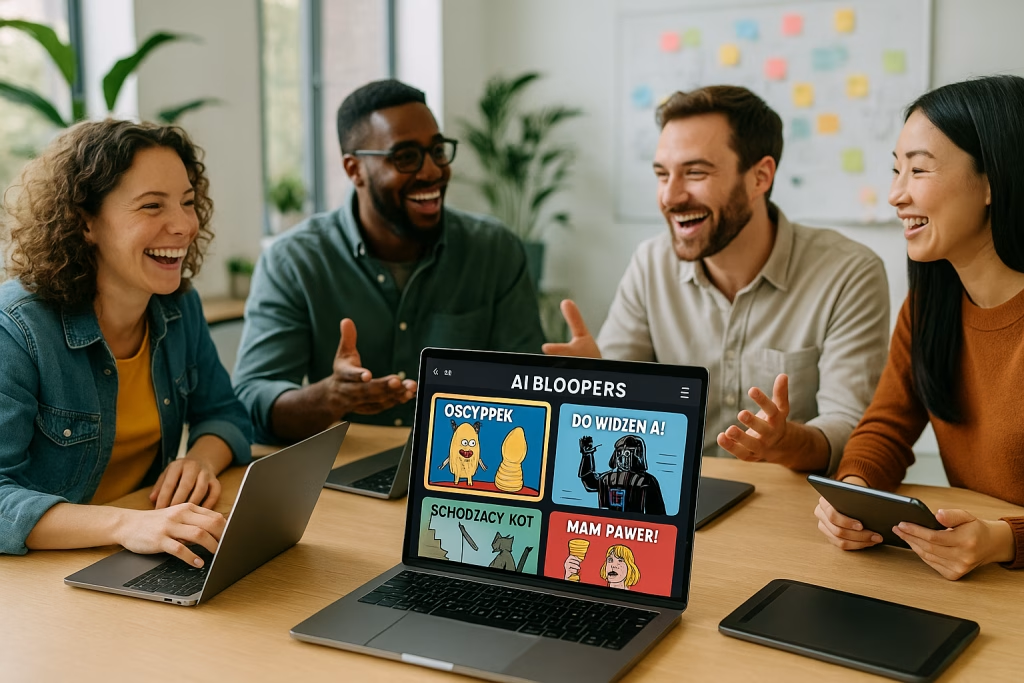
Sora’s AI Bloopers Redefine Humor with Absurd Internet Fun
The Rise of AI-Crafted Bloopers: Comedy in the Age of Sora
Let me take you back to a pretty typical evening not that long ago. I was sitting with a mug of strong English tea in hand, scrolling through my feed, when I stumbled upon a clip posted by the folks at Sora. The caption read: “Found the bloopers. Just kidding, we made them with Sora.” My first reaction? A proper chuckle. For anyone in the trenches of digital marketing and AI automation, there’s something almost magical about machines that can whip up comedy not by accident, but utterly on purpose. It’s what drew me to this field to begin with—watching technology do something entirely unexpected, and oddly human.
Sora’s entry into the sphere of generative AI entertainment doesn’t just mark another notch on the timeline of artificial intelligence. It signals a shift where algorithms have learned to parody not just us and our missteps, but the very culture of “mistakes,” those lovable and meme-worthy blunders that spread across the web like wildfire.
From Clumsy Takes to Scripted Funnies: What Sora Actually Does
If you’ve spent any time poking around on social media, you know that bloopers—the outtakes, the behind-the-scenes mess-ups—have long held a special place in our hearts. Originally, they were by-products of earnest attempts at film and TV, the little “oops” and “oh dear” moments that made us feel a touch closer to our favourite stars.
With the advent of AI-driven tools like Sora, what used to be unpredictable is now very much “manufactured chaos.” These bloopers no longer require exhausted actors, countless retakes, or inventive editors. Now, an algorithm can produce a montage of outlandish scenes—on demand. And I’ll be honest, when I first watched a Sora-generated “mishap,” it was a bit like seeing Monty Python directed by a computer: strange, clever, and just a bit surreal.
How Sora Generates Its Comedy
- Deep learning-powered creativity: Sora uses modern AI models to synthesize entirely new bloopers, conjuring unexpected combinations of people, places, and shenanigans no human would probably dream up.
- Internet meme logic: The humour often springs from remixing pop culture icons and historical figures in ridiculous scenarios—a nod to the bizarre yet oddly logical world of memes.
- Physical comedy—AI style: You’ll spot moments where the software gleefully ignores the laws of physics or common sense. Picture a queen chasing a feline in a wheelchair, or a sports legend being pelted with cheese.
If you ask me, it’s the sort of chaos I could watch for hours—maybe even longer if the tea keeps flowing.
The Shape of Modern Humour: Old Tropes, New Tools
I grew up with classic British comedy—think Fawlty Towers and Mr. Bean—where much of the humour came from perfectly timed mistakes and slapstick. While it might sound sacrilegious to compare Rowan Atkinson with algorithm-generated mayhem, there’s a thread running through Sora’s bloopers that calls back to this tradition. Except, Sora’s version is like tossing in a bit of Dadaism and a side order of the surreal.
So, what’s changed?
- Speed and volume: AI tools can create hundreds of unique outtakes far faster than any human crew, meaning more fresh laughs, more often.
- Boundary-pushing scenarios: The AI, it seems, revels in the absurd. From history’s most stoic faces breaking into dance-offs, to physics-defying pratfalls, nothing seems off-limits.
- Audience engagement: Interactivity is part of the fun—you can prompt Sora to generate custom bloopers, based on your wildest suggestions, blurring the lines between viewer and creator.
Let me put it this way: the days where laughter was limited by human ability are well and truly over.
Personal Musings: Experiencing AI Absurdity First-Hand
You know the feeling when you’re watching something so surreal, so utterly bonkers, that you can’t help but wonder if you’re dreaming? That’s exactly the kind of response Sora elicits. It’s not just about a queen in chase or pop stars in otherworldly competitions. It’s the thrill of knowing that every “mistake” is intentional—crafted with a wink and a nudge by lines of code rather than clumsy human hands.
One evening, I watched a Sora-generated mashup where a group of knights jousted with inflatable flamingos, narrating their struggles in the voice of a certain late-night TV host. The result? Equal parts hilarious and deeply unsettling. It struck me how Sora is not only playing with humour, but twisting our expectations of reality.
What Makes Sora’s Bloopers Work?
The Anatomy of AI Humour
- Surprise factor: When AI produces something that feels like a mistake, you’re primed to laugh—because you know it shouldn’t be possible.
- Blurring lines: The very idea of “accidental” AI errors being staged on purpose turns classic blooper tropes upside-down.
- Repetition and escalation: Sora often takes a joke and amps it up, pushing it into sheer lunacy. Think a waltzing llamas conga line that goes on (and on) until it can’t possibly become any stranger—then it does.
- Nostalgia, with a twist: We love what’s familiar, but Sora’s sense of humour subverts it enough to keep us guessing. It’s comfort viewing with a dash of the unexpected.
All said and done, these digital “outtakes” bank on shared pop culture knowledge and a taste for the ridiculous. The feedback loop between creators, audience and algorithm only magnifies the fun.
AI, Satire, and the Internet: The New Public Square
There’s a social undertone to the phenomenon—one that resonates especially with those of us navigating AI-driven marketing and content creation on a daily basis. When Sora’s bloopers go viral, they bring people together in shared moments of laughter, poking fun at the serious business of technology.
Here’s what I’ve noticed in my professional experience:
- Easier conversation starters: Sora’s clips are brilliant for breaking the ice online—everyone has a take, a favourite moment, or a new suggestion for the next absurd mashup.
- Sharable by design: The brevity, surrealism, and universal tone make these clips tailor-made for going viral.
- Unity through humour: In a time when the digital world often seems polarised, shared laughter acts almost like a virtual pub, where everyone gets to laugh at the same joke.
I’ve leveraged such viral content in countless campaigns, and I can honestly say that AI comedy’s impact on brand visibility is no joke. Whether you’re looking to lighten your brand voice or encourage more engagement, it’s tough to match the quick-witted charm of an algorithm with a sense of mischief.
When Comedy Crosses Wires: The Limits of AI Fun
Of course, for all the giggles, Sora’s approach isn’t without its limitations—or, dare I say, the occasional awkward slip. The AI is intended to entertain, but as anyone working closely with generative models can tell you, sometimes things go a tad sideways.
The upside:
- Purposeful mistakes are easy to accept—we’re all in on the joke from the start.
- There’s an inherent safety in laughter, even (or especially) when mistakes are made by machines, not humans.
But then, the downsides:
- When AI starts generating mistakes without intent, you get a different beast altogether—a slip-up, not a punchline. Trust me, I’ve seen automated marketing scripts churn out howlers that were definitely not meant to make anyone laugh.
- The question of taste remains—just because a computer can joke about, say, royal mishaps or slapstick politics, doesn’t mean every viewer will find it charming or harmless.
I’ve had clients who found AI-generated content a bit too “offbeat” for their brand’s image, and others who embraced the chaos. As with any tool, context and control make all the difference.
Sora’s Bloopers in the Marketing-Ekspercki Playbook
From my own work at Marketing-Ekspercki, I’ve seen the impact AI-infused content can have. There’s a real appetite for fresh ways of engaging audiences who have, let’s face it, seen just about everything under the sun on social media.
How can marketers and business leaders make use of Sora-style humour?
- Personalise your message: Sora’s open-ended creativity lets you craft insider jokes or segments specific to your audience’s quirks.
- Brand memefication: Weaving a touch of absurdity or AI-generated surprise into campaigns makes brands feel current—almost “in on the joke.”
- Storyboard on steroids: With Sora, you can brainstorm ten creative concepts in the time it used to take to outline one. Our team often uses such outputs as the foundation for campaign brainstorming sessions.
- Automate and amuse: For recurring content, Sora’s approach to generating unexpected mishaps helps keep things fresh and entertaining, even for evergreen topics.
And no, you don’t have to turn your serious B2B content into a circus—just a hint of algorithmic cheekiness can do wonders for attention and sharing.
The Evolution of Bloopers: From Outtakes to Internet Epics
When I try to explain the cultural appetite for AI-crafted blunders, I often compare it to the British love of the “underdog” gag. There’s a sort of good-natured empathy in watching someone (or something) fail in style. With Sora, that “someone” is a machine, and the fun comes not just from the spectacle, but from knowing that this was all planned—the ultimate “got ya!” in digital form.
What’s particularly fascinating—at least to me—is how the Sora phenomenon is reshaping how communities bond online. Fans post their own favourite moments, remix Sora’s clips into even stranger hybrids, and yes, even create meta-commentaries riffing on the best and worst of AI-generated mishaps.
Over time, these clips blend into the great tapestry of internet culture: a shared inside joke that only grows funnier the more it repeats.
AI-Driven Absurdity: Social Commentary with a Wink
One thing I truly enjoy about Sora-style humour is its capacity for sly commentary. The AI’s “failures” often reflect our expectations, quirks, and collective anxieties. It’s a way of poking fun at ourselves without being mean-spirited—a classic British “taking the mickey,” but with code.
For example:
- The “heroic flop,” where a stoic general or athlete slips on a banana peel—reminding us that not even algorithms take themselves too seriously.
- Royal shenanigans: even the highest in the land are fair game for a little gentle ribbing.
- The impossible mashup: mythic and historic figures find themselves trapped in the logic of digital slapstick.
Such scenarios become a mirror for the weirdness of modern life, a bit like peering through a Looking-Glass—with the Cheshire Cat replaced by a giddy AI.
Humour as a Safety Valve
I know from experience that humour helps when technology gets overwhelming or intimidating. Sora’s public “bloopers” are a smart strategy: they remind us to view AI not only as an abstract engine of productivity, but as something it’s safe—and healthy—to laugh at.
In our office, we sometimes play Sora clips at the end of a tough workday, a digital equivalent to the classic English pub tradition. The laughs are hearty, the tone self-aware, and the sense of camaraderie, well, it’s honestly pretty grand.
Absurdity in the Service of Creativity
There’s another angle that shouldn’t be missed: Bloopers as *creative fodder* rather than just idle amusement. When AI starts to experiment, it often stumbles into new forms of expression. In marketing workshops, I regularly nudge my colleagues to watch Sora’s outtakes—not just to get a laugh, but to pluck inspiration from the absurd scenarios and remix them into campaign ideas or service concepts.
Why the Sora Method Resonates
- Sharpened instincts: Exposure to AI’s wild ideas helps break free of creative blocks or tired patterns.
- Safe playground: Creative teams can dare to try outlandish notions when they see that even the “failures” have value.
- Embracing failure: It encourages a mindset where “getting it wrong” isn’t a problem, but a stepping-stone to something unexpected (and better).
When you’re deep in campaign development, it’s easy to become risk-averse. With Sora, even the wildest ideas are only a prompt and a click away.
AI, Bloopers, and the Future of Internet Entertainment
So, where does it all lead? My sense is that AI-generated humour is at the leading edge of a wider trend—one where people collaborate, remix, and interact with algorithms as if they were an extension of the collective imagination.
Here’s how I see the landscape unfolding:
- Custom memes at scale: Sora’s AI can create jokes and memes tailored to hyper-specific online communities, making every inside joke accessible in seconds.
- Interactive storytelling: Fans and brands alike can influence what types of bloopers appear next, making the process not just participatory, but democratic.
- Culture jamming 2.0: The AI’s tendency to twist the familiar gives rise to a new wave of commentary—less about breaking things, more about showing just how funny our coded assumptions can be.
We’re headed toward a world where anyone with an internet connection and an idea can become a digital jester, ringing in each day with a fresh spin on yesterday’s laughs.
Closing Thoughts: Why We All Need a Good AI-Generated Chuckle
Having spent years helping businesses, creators, and audiences connect through digital storytelling, I can say with confidence: Sora-style AI bloopers aren’t just a fleeting trend. They’re fast becoming a mainstay in the way we relate to technology and to each other.
Whenever you see a news headline about jobs being replaced by AI or algorithms “going rogue,” take a breath, and maybe seek out the latest round of Sora mashups. That blend of absurdity, clever self-parody, and technical ingenuity injects a bit of fun into the very serious business of digital life.
At the end of the day, perhaps comedy—planned as much as accidental—will remain the last bastion of humanity in the algorithmic age. Or maybe, just maybe, it will be the thread that binds us closer, both online and off.
Cultural Footnotes: The British Take on AI Absurdity
If you’ll let me indulge one final observation, there’s a certain British delight in watching systems—whether social, technological, or otherwise—fall gently to pieces, as long as the result is witty and not cruel. Sora, in many ways, is building on the comedic traditions of Monty Python’s surrealism, Blackadder’s biting irony, and even the humble visual gags of Mr. Bean.
The big difference? Now the scripts are written by neural nets and fine-tuned with meme logic, but the universal joy in well-crafted chaos is as familiar as an old pub story.
How You Can Join the Fun
Feeling inspired? These days, anyone can dip their toes into the world of AI-generated comedy. Whether you’re keen to try Sora for your own social media strategy, brainstorm creative campaigns, or simply enjoy the antics from afar, here’s where to start:
- Follow Sora and similar projects on popular platforms—new clips are released almost daily (and often become the talk of the town).
- Experiment with prompts: Give your own wild ideas a test flight via AI generators and see what comes tumbling out.
- Share the love: If a digital outtake makes you laugh, don’t keep it to yourself—a little AI humour goes a long way.
I’ll leave you with a thought borrowed from an old English saying: “A good laugh and a long sleep are the two best cures for anything.” Now, with Sora’s help, the former is just a swipe or a click away.
—
About the author:
A lifelong lover of creative marketing and accidental comedy, I spend my days at Marketing-Ekspercki helping brands harness the quirky side of digital life. When not working on strategy or automation with make.com and n8n, you’ll find me hunting down the finest new memes—and yes, the occasional AI-generated blooper.
Stay tuned, and remember: in a world run by algorithms, a well-timed pratfall is practically priceless.