
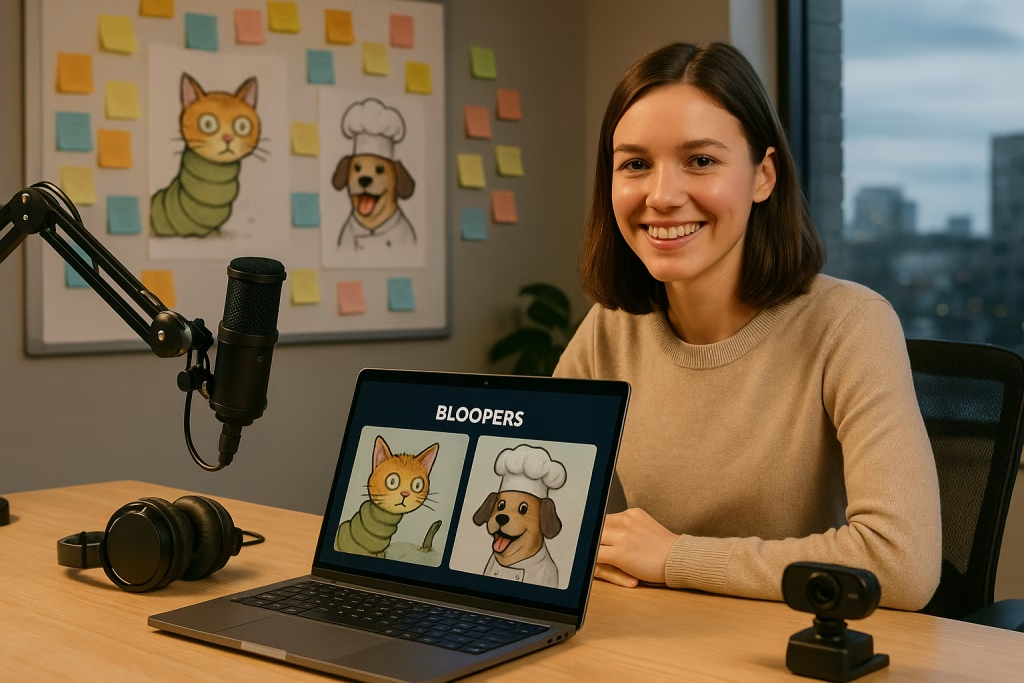
AI-Generated Bloopers with Sora Bring Unexpected Internet Laughter
The Curious Rise of AI-Generated Comedy Clips
There’s a peculiar thrill in stumbling upon a new genre of internet humour. That’s exactly what happened when I first encountered the **AI-generated bloopers crafted with Sora** — a twist that had me both chuckling and raising my eyebrows. Those “outtakes” you see floating across social media, the ones with surreal slip-ups and quirky humour? Surprise — they’re not accidents at all, but carefully (and sometimes quite cheekily) crafted by artificial intelligence.
For someone like me, who grew up loving film bloopers, seeing this “next evolution” of comedic content unfold online feels oddly personal — like watching my childhood gags get an algorithmic remix. It’s as if the lines between staged and genuine mishap got hilariously blurred, thanks to technology learning the rules of funniness, and then gleefully breaking them.
What Exactly Are “AI Bloopers”?
You might be wondering — what are these AI-generated bloopers, if not real mistakes caught on camera? Traditionally, bloopers gave us a peek behind the scenes: actors flubbing their lines, props falling apart, directors losing their composure. Real, unscripted moments that made us see the human side of entertainment.
With Sora, things work differently. The so-called “bloopers” are generated entirely from scratch by an AI system that’s fed gigabytes of data on what typically amuses people. It’s a sort of digital mischief — the algorithm deliberately manufactures errors, awkward slips or outlandish situations, producing sketches that feel both familiar and utterly bizarre.
It makes my inner movie buff ponder — have we finally reached the point where machines can genuinely tickle our funny bones? Judging by the viral success of these clips, I’d say we’re definitely onto something.
How Sora Builds an Artificial Blunder
I’ll admit right up front: there’s something deliciously odd about knowing an AI designed that “faulty” scene you just laughed at. Instead of relying on unpredictable human error, Sora **leans into artificial spontaneity**. It generates oddities like:
- A giant-sized woman in neon pink galloping on a horse, going the wrong way
- Cats crossing over into Olympic sports — with results as bizarre as you’d expect
- Dialogue so off-beat it feels like it came straight from a sketch show after midnight
- Household appliances working overtime for comedic effect (“Kill the fan. I can’t do this anymore. Keep rolling.” — one of my favourites, honestly)
It’s not just random chaos. Sora’s AI has obviously been trained to push the boundaries of absurdity, learning what makes people giggle, cringe, or simply stare in disbelief.
The Recipe Behind the Laughter
So how does Sora manage to master this “planned imperfection”? Here’s the breakdown, based on my own deep-dives and a bit of tech sleuthing:
- Data Gathering: The AI analyses hours upon hours of classic bloopers, comedy sketches, viral mishaps, and sitcom slip-ups, building an internal catalogue of what usually gets a laugh.
- Pattern Creation: Using machine learning models, the system identifies key elements of humour — timing, surprise, repetition, misdirection — and creates templates for generating its own content.
- Randomisation with Intent: The algorithm then introduces controlled randomness into scenes: swapping character roles, warping dialogue logic, adding improbable props or physical expectations, all in the name of comic effect.
- Testing & Refinement: Feedback loops, often powered by real audience reactions, help the AI refine its techniques, choosing the edits that land best with viewers.
And yes, sometimes those attempts at manufactured humour miss the mark. But in a sense, even the “cringey” failures become part of the fun, much like a stand-up act bombing onstage.
AI Comedy and the Surreal: When the Algorithm Writes the Joke
The true magic — or perhaps madness — of these AI-generated bloopers is how often they tiptoe right up to the absurd. There’s an almost British sense of humour about it: dry, tongue-in-cheek, and just the right amount of surreal. Being a bit of an aficionado of European comedy myself, I see echoes of Monty Python and ‘Little Britain’ in the randomness these bots concoct. Sometimes, it’s punny. Sometimes, it’s downright bonkers.
Examples of Next-Level AI Absurdity
Picture this — a digital clip opens with the Queen of England and Michael Jackson moonwalking to the same beat during a birthday party for… a hedgehog dressed as Elvis. No scriptwriter would dare; the AI jumps right in.
Or perhaps it’s the classic football disaster: instead of the striker missing the goal, it’s the pitch itself that moves, sending everyone — fans, referees, and a stray dog — tumbling into a giant bowl of jelly. These aren’t spontaneous whoopsies; they’re the off-kilter dreams of a machine tasked purely with entertaining us.
I’ve shared some of these gems in my friend group chats, just to see the reactions. Amazingly, the humour seems oddly universal. Even those who normally give memes a miss will at least snicker at a cat running a marathon and then offering a medal to the confused commentary team.
The Viral Surge: Why AI-Generated Gags Catch On
There’s a reason these artificially crafted bloopers have such wildfire potential online. We’re all natural collectors of oddities, aren’t we? Social media thrives on shareable moments — especially when they combine surprise with a healthy dose of the ridiculous.
Whenever a new batch of Sora’s bloopers appears, I notice the same thing in my feeds:
- Clips shared hundreds of times within hours, accompanied by comments like “I can’t believe AI did this!”
- Threads full of people trying to guess if the mistakes were real, or if they’d been cooked up by an algorithm
- A cascade of copycats, with users remixing or parodying the bloopers, feeding a new subculture of “synthetic mischief”
For a marketer like me, it’s a goldmine. These clips harness the raw emotion of surprise and the universal appeal of a good laugh. They break up the monotony of the online scroll — suddenly there’s something new to talk about, debate, and riff on.
The “Escalation Principle” in AI Comedy
Every time I revisit Sora-produced reels, I’m struck by a clear pattern: each new video is somehow zanier than the last. There’s a sense of constant one-upmanship — as if the AI, egged on by audience applause (or perhaps just internet cynicism), is determined to raise the stakes with every single outing.
The escalation keeps things fresh and, crucially, unpredictable. That might be why it’s so addictive. There’s a thrill in not knowing just how weird things might get — like opening a box of Christmas crackers and never quite knowing if you’ll get a joke, a crown, or a fake moustache.
If you’re someone who thrives on the “edge of chaos” online, these algorithms are delivering right to your doorstep.
The Human Element: Can Artificial Fails Really Amuse?
As much as I enjoy watching these clips, there’s an itch at the back of my mind. Is an AI ever truly as funny as a human? Or is something lost when “failures” are designed instead of discovered?
I once spent an afternoon at a friend’s family home, watching old VHS tapes of TV outtakes. There’s an unmistakable glow to real human blunders: the stifled giggles, the desperate attempts to stay in character, the gaffes that reveal just how gloriously fallible we are. That warmth, that nigh-universal “oh, I’ve been there” moment, is still something that AI occasionally struggles to recreate.
Yet, when I see a Sora-generated spoof get it right — a chair collapsing at exactly the wrong time, a dignified news anchor suddenly breaking into spontaneous breakdancing because of a scripted “AI malfunction,” I can’t help but laugh just as much as I did with the classics.
It’s a new kind of comedy — deliberately programmed, perhaps a touch less heartfelt, but still effective. There’s room in my entertainment diet for both.
The Subtle Art of “Synthetic Fun”
One thing I’ve noticed is just how carefully the best AI bloopers walk the line between authentic and artificial. The downright bizarre ones are hilarious in their own right, but those that get closest to mimicking human behaviour — those little moments of relatable awkwardness — end up feeling almost eerie.
Some of my personal highlights:
- AI-generated news anchors mixing up their cues and breaking character
- Roundtable discussions where every participant somehow answers the wrong question — yet pretends everything’s fine
- Family dinner scenes with utensils swapped for odd objects (flowers instead of forks!) but everyone blindly carries on
Sometimes the overtly “robotic” execution is the joke itself. Other times, the subtlety creeps in, making you do a double take.
The Feedback Loop: How Audiences Shape AI Comedy
Here’s something fascinating: feedback from real people is woven right into these clips’ creation. When you or I watch, laugh, or even groan at an AI blooper, that reaction is data. That data, in turn, gets fed back into the model, helping to refine future attempts at humour.
I almost feel part of an elaborate inside joke every time I interact. It’s the meme-factory equivalent of tossing peanuts to a stand-up comic — except the comic is a neural net.
The best part? The system learns:
- Which types of gags land with different demographics
- What timing tweaks improve comedic beats
- The degree of absurdity audiences can handle before bewilderment trumps laughter
This feedback loop means that, in a very modern sense, we’re all co-writers in the script of synthetic comedy. Not quite as glamorous as working in a writers’ room, but just as satisfying.
Cultural DNA: A Hint of Polish, a Dash of British, Sprinkled with Internet Kitsch
My background in British and Central European humour gives me a unique lens here. Polish comedy thrives on a peculiar mix of straight-faced absurdity and biting irony. British classics, meanwhile, delight in wordplay, dry wit and situations gone spectacularly awry. Somehow, Sora’s brand of AI slapstick manages to blend those flavours with a meme-ready, internet-hardened attitude.
When I spot a reference — maybe a nod to an old sketch show, or a scene so stereotypically awkward it could only have come from this part of Europe — I feel an odd kinship with the algorithm. Suddenly, digital laughter bridges borders.
Public Reception: Not All Are Fans — and That’s OK
Of course, not everyone is as enamoured with synthetic silliness as I am. Some say the jokes wear thin, or feel too formulaic after bingeing through a few dozen clips. There’s a risk that, over time, algorithmic humour could get caught in its own loops, serving up similar punchlines until the novelty wears off.
I totally get that. There’s something to be said for the unpredictability of real human chaos — the magic, sometimes, is in the messiness AI seeks to replicate, not engineer from scratch.
Still, there’s an audience for everything. And as long as these digital jesters keep experimenting, I’ll be there, popcorn in hand, delighting in the spectacle (and occasionally groaning at the odd dud).
Community and Conversation: The New “Watercooler”
What strikes me most is how these AI bloopers become talking points in their own right. Where once the office watercooler or the local café provided space for joke-sharing, now it’s comment threads and DM groups humming with hot takes and rapid-fire memes.
Sometimes a clip will go viral for the wrong reasons — eyes rolling at an algorithmic flop, or commiserating over just how far-fetched things have gotten. Other times, the joy of the blooper is in the communal reaction — a shared groan, a bemused shrug or a burst of collective laughter. In a sense, these “found errors” have become new markers of internet culture — little badges of inside knowledge traded across digital campfires.
Behind the Curtain: Tech, Trends and Marketing Insights
I can’t help but shift into my marketing-analytics mindset here. The virality of these clips is no accident; it’s the careful blending of three internet currencies:
- Novelty: First-time viewers are intrigued by the possibility of AI going off-script (even when “off-script” is meticulously engineered)
- Shareability: Short, punchy formats make it super easy to pass the content along to friends, family or perfect strangers
- Meme Potential: Each clip acts as a seed for further remixes, riffs or parodies — meta-humour that loops endlessly
Brands and creators have started to tap into this, commissioning their own AI-generated outtakes for campaigns, or embedding similar mechanics into interactive ads. The line between entertainment and marketing blurs, and I, for one, am both amused and a touch envious at the cleverness of it all.
Automation, AI, and the Future of Fun
So, where does it go from here? As someone steeped in the world of business automation and AI-driven campaign strategy, I see the writing on the wall. We’ll likely see:
- More customisable humour — choose your favourite characters, themes or even in-jokes for bespoke blooper reels
- Integration with chatbots and AI companions, who’ll “break character” just for laughs
- Crossovers with AR/VR, placing YOU into the blooper scene for maximum immersion
It’s a new playground for creativity, and I’m just itching to see what the next crop of Sora’s digital jesters will cook up.
Personal Reflections: Why Synthetic Laughs Still Matter
As much as I adore classic, unscripted comedy, there’s a special place in my heart for the synthetic kind. Perhaps it’s the novelty, or maybe I just get a kick out of technology doing something so thoroughly human.
Yes, there’s a degree of distance — an unmistakable flavour of the uncanny — but isn’t that part of the fun? For every person who bemoans the “death of true comedy,” there are three more sharing Sora’s latest clips and adding their own spin. The conversation evolves, and so does the sense of community.
In my own work, I see opportunities everywhere. AI-generated humour is a tool, a toy, and sometimes a bit of a trojan horse: sneak in an idea, spark a conversation, give people something to chew on between the news cycle and the workday grind.
Oddly enough, embracing synthetic fun has made me more appreciative of the moments when things go gloriously wrong in real life. I find myself more willing to laugh at my mistakes — or, failing that, to commission a little AI edge-case for a chuckle.
And let’s be honest — sometimes, when human error is in short supply, a machine-crafted “oops” is just the ticket.
Summary: The Blunder-on-Demand Era
The digital world spins at dizzying speed, but one thing never goes out of style — a good, hearty laugh. With tools like Sora at the helm, bloopers have become more than just relics of TV sets or movie sets. Now, **mistakes themselves are a content genre, spun up on demand with algorithmic flair and a distinctly internet-age wink**.
For my part, I see this as the natural evolution of both technology and comedy. We’ve handed creative power — and a good measure of mischief — over to the algorithms. And, rather surprisingly, they’ve taken up the challenge, serving us a buffet of digital folly that’s both timely and timeless.
So next time your feed explodes with a clip of penguins figure-skating in the Sahara or a tea set interviewing politicians about climate change, take a second to savour it. Somewhere, an AI dreamed up that madness, and — for a brief moment, anyway — brought an army of strangers laughing together.
And if you ask me, that’s something worth celebrating — however you slice, code, or meme it.
Further Reading:
- If you want to see Sora’s own creations, check their official channels — the madness never stops.
- Keen on trying your hand at your own AI-assisted content? Tools like make.com and n8n make it easier than ever to blend automation, creativity and a hint of chaos.
- For classic blooper purists, don’t worry — there’s room in the world for both the unscripted and the algorithmic. Embrace the joy wherever you find it!