
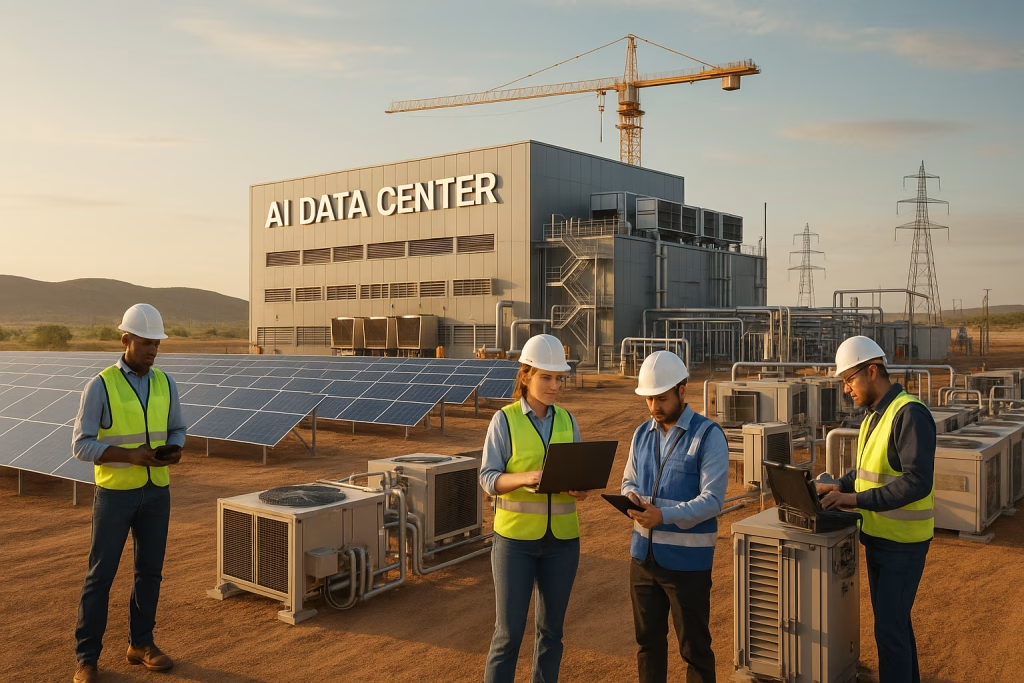
OpenAI, Oracle, SoftBank Expand AI Compute With Five Stargate Sites
If you’d told me even a year ago that private tech giants would announce five fresh mega-sites for artificial intelligence compute — each resembling a mini power-plant in scale, each pumping billions into American soil — I’d have thought you were pulling my leg. Yet here we are. The recent joint announcement from OpenAI, Oracle, and SoftBank isn’t just another press release in the AI race. It marks a genuine turning point in how we think about the physical backbone of artificial intelligence: actual gigawatts of processing power, new towns on the tech map, serious jobs, and a ripple effect across multiple industries.
The story behind these five new Stargate data centres in the United States strikes me as something much larger than just a typical infrastructure rollout. As someone who’s spent years watching the interplay between technology, investment, and regional economies, this feels like the closest we’ve come to an industrial revolution for AI — not hyperbole, but a substantial realignment of priorities and resources.
Let’s peel back the layers of this announcement and see what it means for business automation, marketing, the evolving IT services landscape, and the social fabric of the communities about to witness a tech boom up close.
The Stargate Project: Laying the Groundwork for an AI Future
More and more of my conversations lately revolve around capacity — not just of teams or software stacks, but literal, hard-to-come-by compute power. For OpenAI, Oracle, and SoftBank, announcing five new Stargate facilities is less about publicity, and more about getting ahead of a looming shortfall in global AI infrastructure.
What’s so special about Stargate?
- Unprecedented scale – Each site aims to contribute to the staggering 10 GW (gigawatt) target set for AI compute power by the end of 2025. For reference, the average nuclear power plant produces around 1 GW.
- Partnership muscle – Oracle brings deep expertise with its cloud infrastructure, while SoftBank leans in with financial firepower and renewable energy ambitions. And of course, NVIDIA chips tie the ecosystem together on the hardware side.
- Speed – The clock is ticking. These builds are not speculative: shovels are in dirt, equipment is being installed, and deadlines have teeth.
I’ve read plenty of fluffy AI news over the years, but seeing $400 billion already committed (with an eye to $500 billion total) — well, that’ll make even a seasoned tech observer sit up a little straighter.
Where the Compute Gets Built: Stargate’s New American Homes
Choosing sites for billion-dollar data centres is never random. Here, I’ve noticed a few common threads: proximity to robust energy grids, the potential for renewable sources, local incentives, and the ever-critical supply of skilled labour. Out of more than 300 applications spanning 30 states, only a select few have made the cut so far.
Oracle’s Trio: Texas, New Mexico, Wisconsin
- Shackelford County, Texas – Deep heartland territory, boasting favourable land policies and ready access to power lines. I can already sense how regional contractors, suppliers, and graduates will flock to opportunities here.
- Doña Ana County, New Mexico – A slightly quieter location, but no less strategic. New Mexico’s push toward blending technology and clean energy gives this site an extra edge.
- Wisconsin (with Vantage Data Centers) – Upper Midwest tech isn’t just about Chicago anymore. Oracle’s partnership with Vantage signals an intent to tap both urban and rural workforces, and leverage local supply chains.
SoftBank’s Duo: Ohio and Milam County, Texas
- Lordstown, Ohio – Historically an auto hub, now on track for a data-driven renaissance. Construction is already underway, bringing a sense of anticipation I haven’t seen since the heyday of Midwest manufacturing.
- Milam County, Texas (with SB Energy)
- A blueprint for fast growth: up to 1.5 GW delivered by SB Energy within 18 months.
- Direct ties to renewable generation, making this not just a tech story, but one about green infrastructure being put into practice.
Honourable Mention: Abilene, Texas
Already up and humming, this campus hosts live deployments on Oracle Cloud Infrastructure and forms the spiritual – if not operational – heart of Stargate’s journey so far.
Why the Numbers Matter: Scale, Investment, and Jobs
Big tech investment always makes headlines, but it’s the interplay between dollars, watts, and jobs that really tells the tale.
- Investment Committed: $400 billion and counting, with intentions to breach $500 billion as the project expands.
- Compute Power Target: 10 gigawatts of AI “muscle” by the close of 2025. For perspective, that’s nearly seven or eight of the world’s largest nuclear reactors’ worth of energy, but channelled into machine learning workloads.
- Employment Impact: Oracle’s four main data centres alone promise up to 25,000 local jobs, with tens of thousands more across related sectors — electricians, construction crews, power grid operators, IT technicians. Jobs ripple outward, supporting shops, diners, housing… all the little cogs that keep regional economies ticking.
Having witnessed the slow uptake of cloud infrastructure in past years, this new momentum feels quite personal to me. There’s a sense that the entire AI field is getting a shot in the arm, one that spills benefits over into sectors as diverse as shipping, logistics, real estate, and consumer tech. My conversations with colleagues lately tend to come back to the same phrase: “everyone’s getting a slice.” That includes not just specialist engineers, but also enterprising local suppliers and service businesses who never thought they’d see a tech boom reach their postcode.
Suppliers, Partnerships, and the Hardware Backbone
It’s easy to forget in the era of serverless software and slick APIs, but none of this happens without actual iron (well, aluminium and silicon, mostly) behind the scenes. This Stargate expansion puts a fresh spotlight on something we all sense but rarely discuss: physical limitations.
- Oracle Cloud Infrastructure (OCI): Not just a vendor, but an anchor. OCI will operate the core data cloud for these sites, shaping the way workflows move for every AI company plugging into this backbone.
- SoftBank and SB Energy: Crucial for speeding up deployment by dovetailing renewables with compute load. My friend over in the energy sector regularly quips that “AI now demands as much juice as a steel mill,” and he’s not exaggerating.
- NVIDIA’s Contribution: Bringing in GPU systems – notably the NVIDIA GB200 superchips – to handle AI’s computational appetite. NVIDIA’s own target is to power 10 GW globally by 2026, with a whopping $100 billion earmarked for hardware build-out. It’s a hardware renaissance in progress.
Seeing these giants share the same table isn’t merely convenient for them — it signals to smaller firms and automation innovators, myself included, that there’s a stable, future-proof ladder being built to climb ever-higher computational requirements.
Why Local Communities Care: Energy and Social Responsibility
As jazzed as I get about new tech, I’ve seen the local pushback that can accompany massive server farm rollouts. People worry: will AI data centres strain our grid, sucking up cheap power and driving up prices for the average Joe? The Stargate approach, from what I’ve gathered, makes real attempts to sidestep these pitfalls.
- Grid Strengthening: Rather than just taking, Stargate sites commit to shoring up local energy infrastructure, helping stabilise the wider network.
- Demand Flexibility: There’s a deliberate move toward feeding energy back to the grid or reducing draw during peak hours. So rather than acting as an energy parasite, these campuses become partners, balancing demands as part of wider community planning.
- Focus on Sustainability: Especially with SoftBank’s SB Energy arm involved, there’s drive to incorporate renewables — an attempt, at least, to use AI’s appetite as a driver for greener energy infrastructure. Frankly, I wish more tech rollouts had this kind of ethos.
Having grown up in a town that saw more than its fair share of one-company booms and busts, I can’t stress enough how significant it is that employment, skills, and energy costs are front-of-mind from the get-go. Otherwise, communities are left to clean up the mess when the shine wears off.
The Strategic Logic: Why Expand at This Scale, This Fast?
This isn’t just a badge-of-honour exercise for OpenAI or its partners; it’s dealmaking with a very deliberate urgency.
- Global Competition: The US and Asia continue to jostle for primacy in AI. These sites will anchor the US both as a production powerhouse and a home for AI innovation.
- Supply Chain Security: COVID-19 taught us hard lessons – having local, robust infrastructure shields companies against unpredictable global shocks and avoids over-reliance on far-flung data sources.
- Go-to-Market Speed: With compute requirements skyrocketing, whoever gets their hands on next-gen data centre capacity first can leapfrog competitors. I remember the rush for cloud spots a decade ago — feels almost quaint compared to today’s gigawatt arms race.
The Domino Effect: Wider Industry and Business Implications
For those of us weaving AI automation into sales, marketing, and business processes, the growth of Stargate has a very direct impact — even if we’re a thousand miles from the nearest blade server.
Accelerated Innovation in Automation and Marketing
- Shorter Lead Times: With compute at the ready, new models and automations can hit the market unencumbered by long queue times for training and deployment.
- Better Reliability: Distributed data centres reduce the risk of outages, meaning your AI-driven campaigns — whether in e-commerce, lead scoring, or advanced customer segmentation — become more robust.
- Room for Experimentation: Easier (and sometimes cheaper) access to compute means more ambitious pilots, faster iteration cycles, and, frankly, boldness in campaigning. My team can dream bigger when the infrastructure keeps up with our pace of innovation.
Workforce Development and Skills Shift
Local communities, once reliant on agriculture or legacy manufacturing, now train workers for data centre maintenance, IT logistics, and even AI ethics functions. It’s clear that upskilling isn’t just a nice-to-have, but a new lifeblood for regional economies. Young people who once left for Silicon Valley now find futures in their own backyards.
Energy Markets and Sustainability: New Frontiers
With such huge sites plugging in, neighbouring renewables projects (wind, solar, even next-gen nuclear) get a real business case. Utilities see opportunities instead of threats, partnerships emerge faster, and the clean energy transition gets a somewhat unlikely but very real boost.
The Technical Side: What Inside Stargate Powers Next-Gen AI?
From my chats with engineers, the “nuts-and-bolts” approach of Stargate deserves a closer look. After all, most of us rarely lift the bonnet of a data centre, even if we work with AI daily.
- High-performance Networking: Stargate sites run on the backbone of fastest-in-market fibre and proprietary routing, tightly woven with redundancy measures that would make a Swiss watch blush.
- Immersion Cooling and Green Energy: To fend off the heat generated by countless GPUs working in concert, new methods like liquid cooling and on-site renewables are no longer the stuff of sci-fi. They’re bread-and-butter tech, reducing environmental impact and boosting efficiency.
- Advanced Security Protocols: Anything built at this scale becomes an instant target, so edge-to-core encryption, constant monitoring, and continuous penetration testing are par for the course.
- AI Optimised Hardware: With NVIDIA’s most advanced chips in the driver’s seat, processing AI workloads – from generative imagery to real-time natural language – happens in quantum leaps, not baby steps.
It’s easy to get lost in giddy statistics, but remembering that all of these advances rest on servers, cables, and hardworking people is grounding. Every AI revolution, in the end, is powered by the unglamorous chore of designing, building, and maintaining physical space for data to live and breathe.
Practical Impact: How AI-Driven Businesses Stand to Benefit
As someone who’s spent countless hours troubleshooting slow model inference, handling bottlenecks in campaign automation, and fretting over looming compute bills, I can’t help but feel downright cheery reading these Stargate updates. Here’s what I see as the chief knock-on effects for marketing, sales support, and AI-powered automation businesses:
- More Predictable Access: Say goodbye to compute rationing for model training — tighter, on-demand cycles let businesses launch products faster and with more swagger.
- Global Expansion Paths: US-based compute capacity, strengthened by more decentralisation, means European or Asian automation teams no longer have to queue for access or worry about data sovereignty issues as much.
- Marketing Automation „Upshift”: With the extra horsepower, campaigns with multi-stage, adaptive personalisation — once the preserve of only the biggest spenders — will be within reach of mid-tier players, not just giants.
- AI Business Service Confidence: In negotiating with clients on ambitious AI rollouts (think n8n and make.com orchestrations), I can actually promise robust delivery schedules backed by real infrastructure. No more biting my tongue, hedging on timelines, or praying cloud credits won’t run dry mid-project.
Challenges on the Horizon: Not All Sunshine and Roses
Now, while I’m genuinely optimistic, I wouldn’t be honest if I didn’t air a few worries. With great scale comes even greater risks — for business, society, and the planet.
- Energy Demand vs. Supply: Even with renewables, plugging in sites at multi-gigawatt footprints can outpace grid upgrades, especially in less-developed regions. Planning becomes a chess match between builders, utilities, and regulators.
- Environmental Trade-offs: Liquid cooling, battery storage, and renewables soften AI’s footprint, but still, these campuses chew through resources. It’s a race to balance benefits against costs — both environmental and social.
- Workforce Displacement: While millions of jobs will be created, some skill sets — especially in traditional manufacturing — may face obsolescence. Retraining and education need to keep pace with the changing landscape, or else we risk leaving entire groups behind.
- Regional Inequities: Not every town can win a Stargate site, and those who miss out might feel the sting of being “left behind” in a new digital divide.
I’ve seen first-hand how local optimism can turn on a dime if promises evaporate or unintended costs pile up. Ongoing dialogue — and honest reporting — will matter just as much as dazzling launch events.
The Road Ahead: Further Stargate Expansion, Further Implications
If there’s one thing I’m certain about, it’s that these five Stargate centres are the beginning, not the end. Executives at OpenAI, Oracle, and SoftBank have made no bones about their intent to keep adding sites, keep nudging that investment target north of half a trillion dollars, and keep the “snowball effect” rolling across every region, every sector.
- As more towns and states vie for a place in this AI-powered future, local and state governments will need bolder plans — investing in education, negotiating for fair energy rates, and devising clever ways to attract, retain, and support these mammoth facilities.
- Meanwhile, businesses like mine are eyeing the pipeline, anticipating offerings that will reshape what’s possible with AI-driven sales, content marketing, and workflow automation.
- There will be more scrutiny, too, from regulators and public watchdogs. That’s only right — transparency and accountability must rise along with the towers of blinking server lights.
If you’re like me, you can’t help but scan the horizon after news like this, wondering what the ripple effects will look like in six months, a year, five years. Personally, it feels just a bit surreal — those big numbers seem, well, almost too good to be true. But I’ve found that when titans start laying real foundations together, change becomes inevitable.
Final Thoughts: A New Chapter for AI Infrastructure
Stargate’s expansion represents not merely a technological upgrade, but a shift in how entire societies approach work, energy, and the promise of artificial intelligence. The headline numbers — gigawatts, billions, tens of thousands of jobs — grab attention, but it’s the minute-by-minute impact on local economies, entrepreneurial ambitions, and everyday business operations that will determine just how far-reaching these changes become.
As someone who makes a living at the bleeding edge of automation, sales enablement, and AI-powered business support, I can’t help but look ahead with a mix of anticipation and cautious realism. New Stargate sites mean I can train and deploy mind-blowing martech solutions faster, more securely, and at greater scale. But they also mean staying nimble, alert to new responsibilities and the need for inclusive, broad-based progress.
So, while it might sound grandiose, I suspect future generations will look back at this run of announcements and chalk it up as the moment when AI infrastructure “got real”. And as I keep tinkering with make.com or sketching the next big sales automation flow in n8n, I’ll do so knowing the floor under my feet is just a little bit stronger, a little bit broader, than it was before.
Because truly, in my corner of the economy and yours, this isn’t just more compute in the making — it’s the making of something bigger altogether.